
Event discussed how the sector can improve Brazil’s position on the global agenda for climate change, the energy transition and food security during COP30
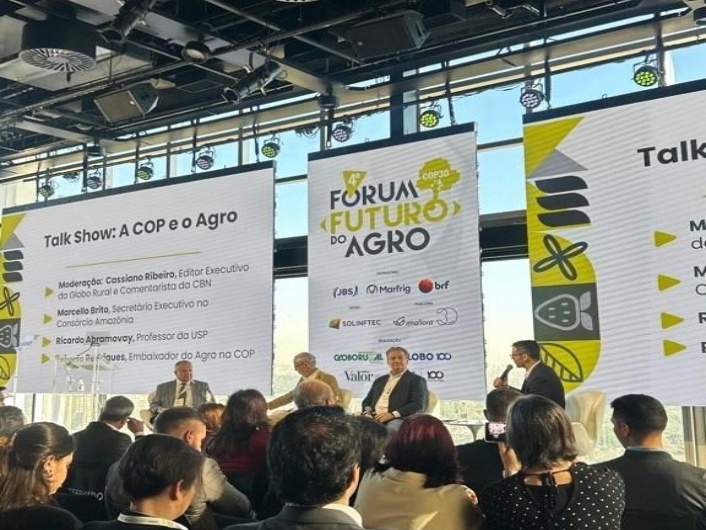
Sustainable agribusiness was at the center of discussions at the 4th Future of Agriculture Forum, held in São Paulo on June 18. During a full day of debates, representatives of the whole production chain, from farms to retailers, met with public officials, academics and civil society leaders to discuss the challenges and opportunities that COP30 brings to Brazil. The event focused mainly on the role of agribusiness in the global agenda on climate change, the energy transition and food security.
The activities included a series of panels moderated by journalists from TV show Globo Rural and business newspaper Valor Econômico. The forum opened with a roundtable debate on the sector’s role in climate negotiations, bringing together prominent figures such as Professor Ricardo Abramovay from the University of São Paulo’s Energy and Environment Institute; Roberto Rodrigues, former agriculture minister and “agricultural ambassador” at COP 30; and Marcello Brito, executive secretary of the Amazon Consortium of State Governors.
During the day, industry executives and rural producers explored key topics such as the creation of incentives for sustainable production and consumption. The participants also addressed green financing – identified as one of the biggest challenges for the sustainable transition in agriculture.
Farmers presented a series of best practices they have already adopted, sharing their experiences and positive results on their properties and demonstrating how innovative techniques can be integrated into economic development.
“Brazil does not need to create solutions from scratch. It just needs to scale up best practices that are already underway, such as regenerative land management, crop-livestock-forest integration, and the rational use of natural resources, which are already being implemented at different scales and in different regions. The challenge is to make these practices financially viable, offering adequate remuneration to producers and cultivating greater appreciation among end consumers,” says Bia Marchiori, one of the event’s participants, who is responsible for the technical, knowledge and social and environmental safeguards aspects of Vale’s 2030 Forest Goal.
Technical assistance and the strengthening of public policies were also identified as crucial for the sustainable transition, especially for small and medium-sized producers. “In all, 59.1% of the participants said that technical assistance is a key factor for productive inclusion,” says Marchiori. “Access to appropriate technical guidance can accelerate the adoption of innovative practices and attract investment to the sector.”
On the topic of food security, Marchiori stresses that the biggest challenge is “to produce more with less impact, increasing productivity without expanding land area.” This is an essential condition for ensuring access to food amid climate change.
Regarding the energy transition, the debate focused on the potential of biofuels and decentralized agroindustry as feasible alternatives for the rural sector, provided they are accompanied by incentives, infrastructure and scalability adapted to local circumstances.
“One concern is that the discourse on sustainability is still often limited to mitigating negative impacts, rather than dealing with the actual generation of value from positive impacts. Sustainability needs to be integrated into strategy, mindset change and the construction of models that deliver efficiency, regeneration and inclusion. To achieve this, it is essential to bring different agendas closer together, listening to those in the field, and also to those in the forests, local communities and bioeconomy. Only then will we build systems that are truly environmentally, socially and economically sustainable,” Marchiori says.