
A Fundo Vale partner for over 10 years, Imaflora is among the sector’s leading authorities in Brazil
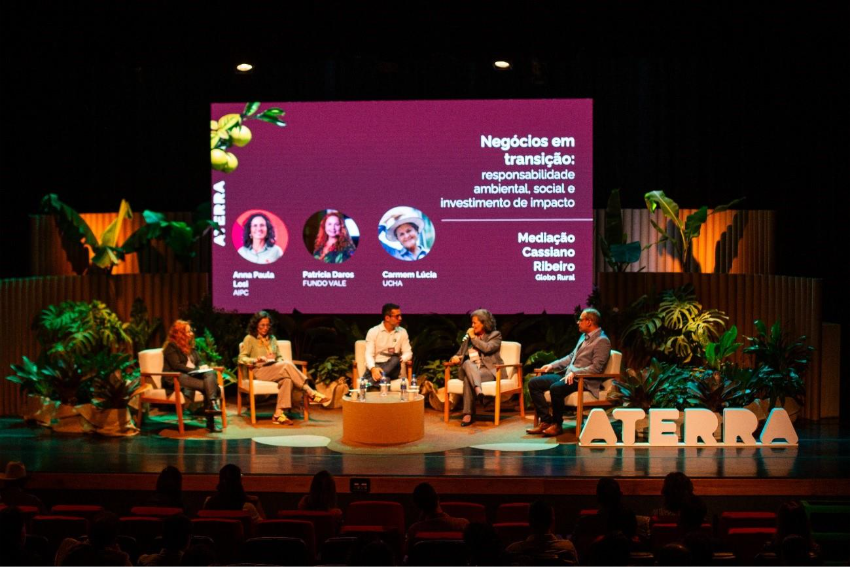
This year, to mark its 30th anniversary, the Institute for Forest and Agricultural Management and Certification (Imaflora) held a meeting in São Paulo to debate key issues for Brazil’s present and future. Called “ATERRA,” the two-day event on August 20 and 21 brought together specialists, rural producers, researchers, traditional communities, businesspeople and public managers from the social and environmental sector to participate in a series of activities.
ATERRA provided a dynamic space for dialogue, culture and content, fostering discussions that traverse the countryside, forests and cities. The goal was to reconcile production and conservation via a just, inclusive and sustainable path in a wide-ranging journey of knowledge, innovation and ancestry.
The event began with a panel featuring three Imaflora leaders, called “Where did we come from and where do we want to go?” The speakers were Marina Piatto, Imaflora’s executive director; Patrícia Cota, deputy executive director; and Tasso Azevedo, board member. After that, Patrícia Daros, Fundo Vale’s director, took part in a panel titled “Businesses in transition: Social and environmental responsibility and impact investing.” The other speakers were Ana Paula Lossi from the Association of Cocoa Processors (AIPC), André Valente from Raízen and Carmem Lúcia from Uchua. The session was moderated by Cassiano Ribeiro from TV network Globo Rural.
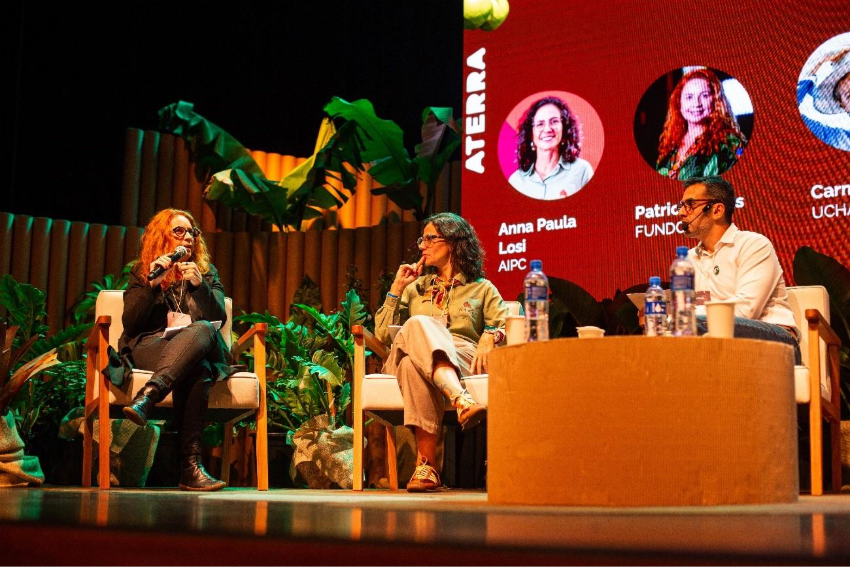
Patrícia Daros highlighted Fundo Vale’s track record in the search for alternative and sustainable production models, especially involving forest resources, with a focus on ensuring better living conditions for local communities. She explained that the work initially focused on strengthening non-governmental organizations and specific support projects. Over time, the challenge was broadened to implement these sustainable models on a large scale.
Fundo Vale’s director also spoke about climate finance as an unavoidable challenge for the social and environmental agenda, emphasizing that real progress depends on more investment in science and innovation, especially focused on social and biological diversity production chains. In her view, a solid scientific basis and innovative processes will be essential to scale up businesses with a social and environmental impact in an effective manner.
“The innovation we seek is not only technological but also process-based. Often, changing the way things are done already brings about major transformations. We have challenges, but I see that progress is being made. Researchers are working hard to improve products such as cocoa, açaí, cassava and many other potential products of social and biological diversity, but there is still a long way to go to transform these chains into examples of progress based on science, innovation and consistent financing,” she said.
During the two-day event, other leading figures were present at ATERRA, such as Thaynah Gutierrez, a youth climate activist; Cida Bento, recognized for her experience regarding diversity and climate; Ricardo Abramovay, a specialist in the agricultural and food transition; André Lima, secretary for deforestation control and regional environmental planning at the Environment and Climate Change Ministry; André Aquino, who talked about climate adaptation and forest economics; and Gleici Cleicii Patauá, who shared proposals for a reimagined economy.
Imaflora and Fundo Vale: A partnership spanning over 10 years
The partnership between Fundo Vale and Imaflora began with support for the “Origens Brasil” (“Brazilian Origins”) accreditation, created by Imaflora and the Social and Environmental Institute (ISA) to bring social and biological diversity products from the Xingu region to the shelves of large cities, highlighting their sustainable origin and boosting enterprises that help preserve the forest. This accreditation promotes transparency and traceability, allowing consumers to access information about products via QR codes. With support from Fundo Vale, indigenous communities and extractive producers have been able to strengthen their production chains, as well as receiving technical assistance, training and working capital.
Another area of activity in partnership with Fundo Vale is the 2030 Cocoa Project, which seeks to restore habitat through sustainable cocoa production, with a focus on strengthening the production chain and generating direct benefits for producers and cooperatives. Imaflora was responsible for implementing two cocoa demonstration production units in the municipalities of Uruará and Marabá in Pará, as well as providing technical assistance and rural extension training to more than 400 people.
Currently, Imaflora is playing a key role in delivering Vale’s commitment to restore 100,000 hectares of land as part of its 2030 Forest Goal. The NGO contributes by supporting the management of social and environmental safeguards in businesses accelerated by Fundo Vale, leveraging positive impact in areas undergoing recovery.
“The partnership between Fundo Vale and Imaflora is built on trust, aligned values and joint work in the pursuit of positive and lasting transformations in the regions where we operate. Over the last 30 years, Imaflora has not only built a legacy of technical excellence but also established itself as a leader in dialogue and coordination with different players in the impact ecosystem,” said Patrícia Daros.