
The panel presented a study by Quintessa, to be published later this month, on the profile of over 100 innovations involving links in the habitat restoration chain, supported by Fundo Vale, the Amazon Investor Coalition, the Institute for Climate and Society and the Itaúsa Institute

Left to right: Juliana Vilhena, Fundo Vale’s strategy, management and impact manager; Natália Cerri, the Itaúsa Institute’s manager; and Carolina Ochoa Koepke, Quintessa partner and land use leader, during São Paulo Climate Week panel discussion at Aya Hub
Forest restoration in Brazil has the potential to add R$19 billion to the country’s GDP and create more than 5 million jobs (half in rural areas) by 2030. However, to realize this potential and achieve its environmental restoration targets, the country will have to invest between R$31 billion and R$52 billion and adopt innovative financing mechanisms, such as carbon credits, parametric insurance and certifications adapted to local conditions.
This topic was discussed at 2025 São Paulo Climate Week, during a panel to launch a study titled “Mapping Innovations for the Brazilian Habitat Restoration Chain.” The study was conducted as part of the Restoration ClimAccelerator program, run by Quintessa in partnership with Fundo Vale, the Amazon Investor Coalition, the Institute for Climate and Society and the Itaúsa Institute, with global support from Climate-KIC.
Juliana Vilhena, Fundo Vale’s strategy manager, participated in the panel, alongside Carolina Ochoa, partner and land use leader at Quintessa; and Natalia Cerri, the Itaúsa Institute’s manager. The panel also featured representatives of some of the innovations selected for the Restoration ClimAccelerator program’s first acceleration cycle, including João Horst, co-founder and CSO of Bluebell Index; Heitor Filpi, co-founder and CEO of Bioflore; and Mariza Monteiro, founding partner and CEO of IVG Tech.
The study, to be published soon, outlines challenges in the habitat restoration process. It also provides an overview of entrepreneurial initiatives that use technology to improve the various stages of restoration. The study identified two key groups: enablers, which are technology-based businesses offering tools and services (such as software, hardware and biomaterials); and developers, meaning the growing number of restoration initiatives and businesses that use these tools to carry out their projects.
“Even when we think about restoration with a broader approach, considering assisted recovery and not just productive models, the challenges are huge. It all starts with the soil, but land tenure is often the first major obstacle, in addition to environmental compliance issues. This is where the opportunity arises for companies that enable restorers to overcome these challenges. Through mapping work, we have seen that another ecosystem of solutions is forming to support restoration and protection. Once this area generates income and has a market, deforestation will no longer make sense. Instead, restoration will create value and discourage the advance of deforestation in areas of natural habitat,” argued Juliana Vilhena during the event.
Key areas of innovation
Brazil, home to the planet’s richest biodiversity and a potential leader in the global climate debate, today faces the dual challenge of curbing environmental degradation and driving the recovery of its ecosystems. In line with the United Nations Decade for Ecosystem Restoration, the country has committed to restoring 12 million hectares of degraded areas by 2030, but studies indicate that less than 3% of this target had been achieved by 2023.
Innovations have the potential to support Brazil in achieving these goals by supporting the inclusion of local communities, reducing costs per hectare, creating new financial mechanisms, addressing technical training gaps in the sector, overcoming bottlenecks in the availability and quality of seedlings and seeds, monitoring carbon and biodiversity, and streamlining the complex land tenure reform and environmental compliance process in the country. Under this program, innovations are divided into five broad areas: land tenure reform and environmental compliance, seeds and seedlings, remote sensing and monitoring, financing and insurance mechanisms, and technical training.
First innovation acceleration cycle and next steps for implementation in the field
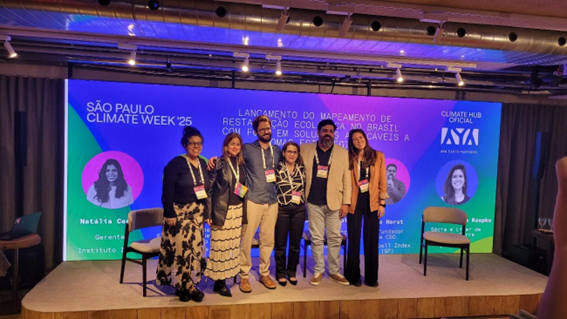
Left to right: Natália Cerri (Itaúsa Institute), Juliana Vilhena (Fundo Vale), Heitor Filpi (Bioflore), João Horst (Bluebell Index), Mariza Monteiro (IVG Tech) and Carolina Ochoa (Quintessa), during the study’s presentation at São Paulo Climate Week at Aya Hub
The study’s innovation mapping work was part of Restoration ClimAccelerator – a Quintessa initiative to promote innovation for the restoration chain. The next phase, following this mapping, will be the first acceleration cycle. This will involve five innovations applicable to the Amazon, combining strategic support, connections with customers and major restorers across the country (such as Mombak, Biomas, Regreen, Systemica and the Belterra Institute) and the development of business models for these innovations.
“This initiative is a pioneer in Brazil as it is an acceleration program that focuses exclusively on innovations in the restoration chain (whereas other programs concentrate on agriculture or the bioeconomy, for example). Restoration ClimAccelerator is working with an entire ecosystem made up of innovation entrepreneurs, restorers, investors and networks working in the field,” said Quintessa’s Carolina Ochoa.
For this first cycle, one innovation has been selected for each area of the restoration chain:
- Land tenure reform – Uirapuru (Pará): a platform to help small producers in the Amazon comply with the law, already working with more than 500 farmers;
- Seeds and seedlings – IVG Tech (São Paulo): in vitro micropropagation of native species, helping reduce costs and increase genetic diversity;
- Remote sensing and monitoring – Bioflore (Minas Gerais): remote sensing to monitor biodiversity, carbon and vegetation cover;
- Financial mechanisms – Bluebell Index (São Paulo): tokenization of environmental assets, assigning economic value to attributes such as soil, biodiversity and water;
- Technical training – Alter do Chão Fire Department (Pará): training for integrated firefighting management.
The next step in this cycle of the program is to put these innovations into practice in pilot projects, connecting with restorers interested in implementing them. Furthermore, new horizons are being planned for the program, expanding the number of innovations supported and carrying out activities in other biomes.
The report highlights that Brazil is at a key moment: it has the potential to be a global leader, both in restoration and as a provider of homegrown technological and biological innovations to tackle the challenges and opportunities of the restoration chain.