
Scaling up agroforestry production offers an urgent, nature-based solution for mitigating emissions from land use
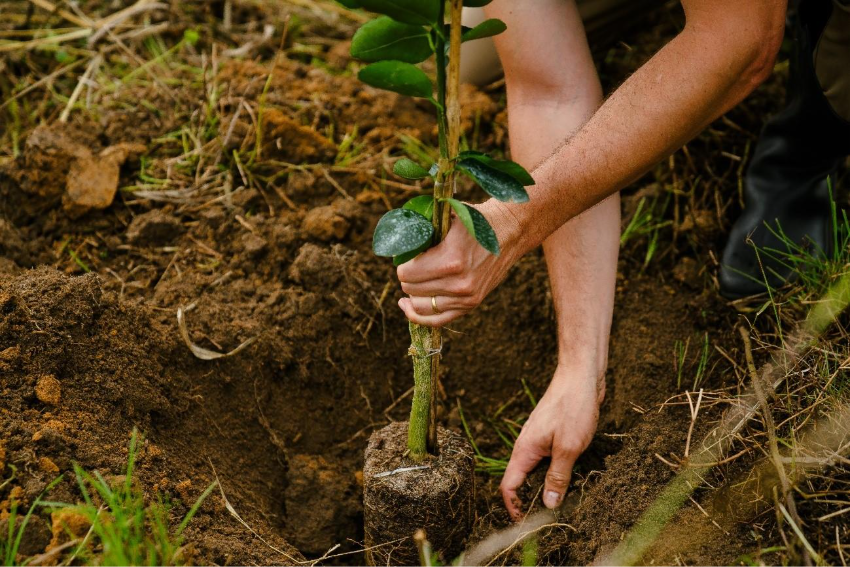
The transition to more sustainable agricultural models is gaining momentum in the hands of those who live their daily lives in the countryside. Adenilson de Almeida Vieira, 28, a native of Serra Grande, Bahia, has been working for two years in an agroforestry system at Fazenda Sucupira, through Courageous Land — a startup supported by Fundo Vale. Before joining the agroforestry project, he worked on banana and cocoa plantations, in which the intensive use of pesticides was part of the routine and natural field residues were simply discarded.
Today, immersed in agroforestry practices focused on environmental recovery, Adenilson speaks with familiarity about green manure and biomass, reflecting his pride in seeing the land transform. “A lot of the area here was dry and depleted. We cleared it, put biomass on the ground, and now the land is rich. It has changed and gained new life,” he explains.
Darwin Daniel Cordero Monge, 37, traded his job working on coffee and cocoa plantations in Venezuela for a new life dedicated to regenerative agriculture in Roraima. Since coming to Courageous Land’s Fazenda Alegria property, he has been a nursery supervisor, guiding colleagues on the management of seedlings and native species, as well as applying what he learns daily in contact with new crops, such as açaí and mahogany. According to him, this experience has spurred his professional growth and generated knowledge for his family.
“We are reforesting this site, trying to change the soil, the climate, and modify many things that are happening, such as climate change. Courageous Land works precisely on this, trying to combat these changes,” he says. Faced with the challenges of deforestation and a long-standing regional tradition of extensive cattle ranching, Darwin believes that continuous learning and dedication to agroforestry can pave the way to a more sustainable future.
Climate mitigation
According to the Intergovernmental Panel on Climate Change (IPCC), nature-based solutions such as agroforestry systems can contribute up to 37% of the emissions reductions needed to limit global warming by 2030. Recent studies from Oxford University show that agroforestry areas featuring native species can capture up to 12 tons of CO₂ per hectare annually.
“On a property scale, agroforestry represents greater financial security and greater ecological and climate resilience. On a planetary scale, it can combine integrated solutions to combat climate change and achieve the UN Sustainable Development Goals,” says Gilberto Terra, co-founder of Courageous Land.
As well as increasing carbon sequestration, agroforestry systems conserve up to 80% more biodiversity than conventional crops (IPBES, 2023), improve erosion control by up to 90% and increase water infiltration into the soil by 50% (Nature, 2024). They also generate attractive financial results: according to a study by Courageous Land, carbon credits linked to agroforestry systems can yield up to US$500 per hectare per year.
The challenge of scale
Despite positive results and scientific recognition, agroforestry systems have yet to achieve widespread global use. Currently, they occupy less than 1% of the planet’s agricultural land (World Bank, 2024). In Brazil, the situation is similar: only 0.3% of rural establishments use integrated agroforestry systems, according to IBGE (2023). The government’s ABC+ Plan has set a target of 5 million hectares of agroforestry by 2030, but implementation is still hampered by a lack of coordination between public policies, financing and technical support.
With the goal of offering free diagnostics on the agroforestry, climate and economic potential of any land in Brazil, Courageous Land has developed an agroclimatic intelligence platform with support from Fundo Vale. The tool combines technology, technical consulting and financial structuring to enable large-scale agroforestry.
“Expanding agroforestry systems requires collaborative work between organizations, companies, financiers and governments. Fundo Vale is investing in partnerships to unlock financing and technical assistance bottlenecks and thereby make agricultural production more resilient to climate change and a vector for environmental recovery,” says Bia Marchiori, who is responsible for the technical, knowledge, and social and environmental safeguards areas of Vale’s 2030 Forest Goal.
Access the platform here.
Debate at COP30
COP30 is set to highlight regenerative agriculture and agroforestry systems as ways to mitigate the climate crisis. Ensuring access to financial resources will be essential to bring agroforestry systems to a continental scale, especially in regions of high social vulnerability. It is expected that climate funds, development banks and private investors will move forward in creating instruments that are more accessible and adapted to the conditions of rural producers.
Carbon credit regulation is also expected to gain momentum. With clearer benchmarks on additionality, traceability and environmental integrity, agroforestry-based projects will be able to access more secure and higher value markets.