
Innovative initiatives aim to strengthen the sustainable forest-based economy, empower traditional communities and connect Amazonian flavors to urban consumers
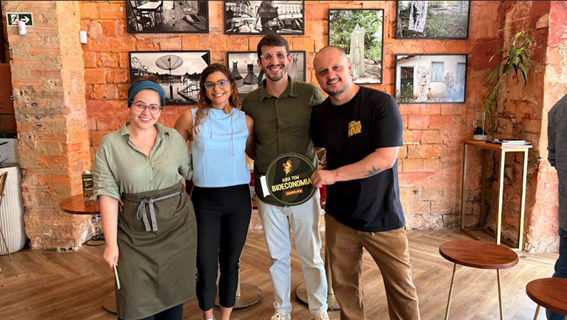
In the run-up to COP30, the Amazon Socio-Bioeconomy Business Association (ASSOBIO), an organization supported by Fundo Vale, is making progress in strengthening the regional socio-bioeconomy through three pioneering initiatives: the “Bioeconomy Here” accreditation scheme, a bioeconomy vending machine project and the ASSOBIO Showcase. These solutions were created to boost recognition of and access to forest products, thereby connecting producers to urban consumers, encouraging sustainable practices, strengthening local production chains, and generating a positive impact for communities living and working in the Amazon.
“Bioeconomy Here” accreditation
The “Bioeconomy Here” accreditation scheme was officially launched in Belém, bringing together around 35 entrepreneurs and professionals from the Pará gastronomic sector at Celeste, a restaurant. The initiative recognizes and supports establishments such as bars, restaurants and cafes that incorporate Amazonian ingredients into their menus, promoting sustainability and appreciation of regional products.
The idea is to bring forest products closer to everyday urban food consumption, creating a virtuous circle between those who produce responsibly and those who consume consciously. “The food sector has huge potential for engagement. By using Amazonian ingredients, establishments help build a sustainable economy. The ‘Bioeconomy Here’ accreditation scheme is a tool for recognition, but also for commitment to the forest and the people who live there,” explained Paulo Reis, president of ASSOBIO.
The launch event highlighted the wide-ranging potential of regional ingredients, with tastings of dishes and drinks made from products such as crystallized cupuaçu fruit, Amazonian soy sauce, jambu gin, Brazil nuts and mead, all supplied by entrepreneurs from the ASSOBIO network. The movement was celebrated by professionals such as Rafael Barros, CEO of the Amazônia na Cuia restaurant chain. “Understanding the Amazon’s products has made a big difference. As well as helping small producers, we also reduce costs and add value to our cuisine,” he said.
Juliana Carepa, coordinator of the “Bioeconomy Here” project, reinforced the strategic moment the region is experiencing. “We are coming up to a very important moment, when the world will be focused on the climate and environmental discussions in the city. So, our establishments also need to be aligned with this. We are committed to encouraging many establishments to use socio-bioeconomy products in a conscious manner. In addition, we will recommend these establishments to our institutional partners, thereby strengthening this important and powerful network,” she said.
To obtain the accreditation, establishments must effectively and continuously use at least one of the more than 1,000 products made by ASSOBIO members, prioritizing native ingredients such as nuts, fruits, oils and spices. The evaluation is based on three pillars: commitment to environmental sustainability, positive social impact, and support for local production chains.
Márcia Soares, Fundo Vale’s Amazon and partnerships manager, highlighted the impact the initiative is having on the region. “As well as helping establishments in Pará’s gastronomic sector stand out, this initiative by ASSOBIO is directly helping strengthen the sustainable forest-based economy. Each Amazonian product that reaches the table means income, dignity and recognition for traditional peoples, as well as encouraging environmental conservation,” she said.
Bioeconomy vending machine and ASSOBIO Showcase
Another notable strategy created by ASSOBIO is its bioeconomy vending machines, which facilitate access for residents and tourists to the flavors and knowledge of the forest. These machines, installed at strategic points in Belém such as the airport and the Estação das Docas (“Dock Station”) venue, offer approximately 30 products, including chocolate, nuts, cosmetics and accessories, all produced by entrepreneurs from the ASSOBIO network. This innovation not only expands the reach and visibility of Amazonian products but also promotes sustainable production and helps integrate the sustainable forest-based economy into the everyday life of large cities.
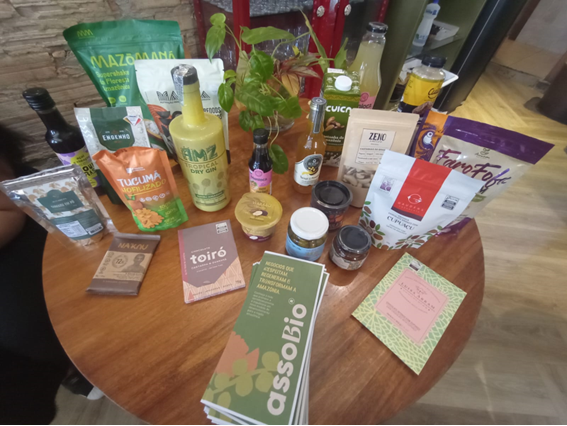
Complementing this ecosystem of initiatives, the ASSOBIO Showcase functions as a traveling exhibition and sales space for products made by members. These products include jambu gin, tucupi sauces, tapioca granola, natural cosmetics and bio-jewelry. The idea is to provide sensory experiences and bring the public closer to the diversity of regional output by taking part in trade shows, other events and strategic spaces inside and outside the state.
To learn more about ASSOBIO, visit https://www.assobio.org/.