
Panel at COP30 brought together perspectives from science, government, the private sector and entrepreneurs to explore ways to support those at the base of Amazonian production chains
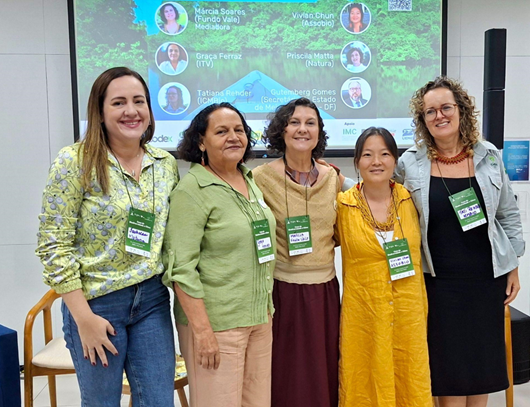
A panel titled “The Bioeconomy: Leveraging Social and Biological Diversity Production Chains,” held at the Biodiversity and Climate House venue during COP30, centered on a key question: how do we turn the forest’s potential into income, conservation and quality of life for the people who live there? Moderating the discussion, Márcia Soares, Fundo Vale’s Amazon and partnerships manager, summarized the challenge: “If we don’t strengthen the foundation of these chains – the people who plant, extract, transform and work in conservation areas and Amazonian towns – we will never reach the bioeconomy’s billion-dollar potential.”
Offering a scientific perspective, Graça Ferraz, senior researcher at the Vale Institute of Technology (ITV) and leader of its Natural Resources Group, presented a project on tucupi (a yellow fermented liquid extracted from cassava) produced in Belém, as part of a broader study on the bioeconomy. This work arose from the Biodiversity Genomics Project, which began in Caeté-Peraçu Extractive Reserve. Tucupi was chosen for the subject of this study due to the ingredient’s visibility at COP30 and cassava’s growing importance in a changing climate.
“Tucupi is part of Pará’s cultural and gastronomic heritage and sits within a well-established chain that links nature and traditional knowledge,” Ferraz said. She cited the lack of data on production and workers as an obstacle and called for the use of geographical indications and collective trademarks to protect tucupi produced in Belém. The idea is to recognize the product’s origin and also the different actors involved: small producers, women who prepare tacacá (a hot, sour, and pungent Amazonian soup made with tucupi) and people who sell the product at street markets.
Representing the government, Tatiana Heder, environmental analyst at the Chico Mendes Institute for Biodiversity Conservation (ICMBio) and coordinator of its social and biological diversity-based economies program, presented CIS Famílias, a system that has mapped around 90,000 families (349,000 people) in 350 conservation areas. It gathers data on people’s location, access to water and education, documentation status and climate vulnerability. “Without the internet, electricity and water, it’s impossible to improve these families’ economic opportunities,” she said, adding that basic social infrastructure and updated records are essential before any productive investment can effectively take root.
Heder noted that ICMBio has placed a strong emphasis on engaging young people. “We are hiring youth from the communities themselves to gather data, organize associations and help families access public programs. When they understand that these policies were achieved through the struggles of their parents and grandparents, they begin to see new possibilities for their own future,” she said. She also emphasized the need to rethink technical assistance. “Professionals who were educated at large universities are not familiar with this diversity. We need to build academic recognition of local knowledge and train extension agents who come from these communities,” she said.
Representing the private sector, Izabella Gomes, sustainability coordinator at cosmetics firm Natura, described how companies can act as catalysts of the Amazon’s social and environmental economy. Over the last 25 years, Natura has incorporated 46 Amazonian ingredients into more than 1,000 products, in partnership with 45 communities, benefiting over 10,000 families and helping preserve more than 2 million hectares of habitat.
Gomes highlighted the Living Amazon financing mechanism, which combines credit through Agribusiness Receivables Certificates with a non-reimbursable fund. “It’s not just about lending money. We have achieved a 100% repayment rate because we provide technical and financial support, ensuring that communities understand their own economic reality,” she said.
She also described a leadership program for young people in 18 communities. “Young people say, ‘I want to continue working with social and biological diversity, but I don’t want to be like my father. I want to have access to technology, I want to understand contracts,’” she said. According to her, bringing professionals from the region itself to the front line strengthens the program’s reach and impact. The mechanism has leveraged R$26 million in three years, including R$13 million in credit for 15 communities, and now aims to expand beyond Natura’s supply chain, reaching other species and production models.
From the entrepreneurial side, Vivian Chun, founder of Moma – a brand of cosmetics based on Amazonian ingredients – and relationship director at the Amazon Socio-Bioeconomy Business Association (ASSOBIO), shared the viewpoint of those transforming forest resources into marketable products. “ASSOBIO now has 126 member businesses that together generate R$52 million per year, benefiting 70,000 people and sustaining over 1,000 jobs,” she said. Most of the enterprises are young (71% were created in 2018 or later) and they operate across food, cosmetics, handicrafts, tourism and other sectors.
Chun outlined three major hurdles: “Small entrepreneurs know their product, but they lack training in business planning, accounting and credit. Financing still speaks the language of big business, retailers favor established brands, and educating consumers about Amazonian ingredients is costly.”
Closing the discussion, ITV’s Graça Ferraz emphasized that expanding solutions in data, financing, technical assistance, markets and consumer education requires focusing on the base of these chains. “Strengthening social and biological diversity means strengthening the people who keep the forest standing,” she said, stressing that many communities still lack electricity, clean water, sanitation and opportunities for youth.
According to Ferraz, the combination of people-centered science, public programs that reach local communities, tailored financial instruments and local entrepreneurship is the path to a bioeconomy that combines scale with social justice. “When innovation considers the realities of those living in the forest, along the rivers and in low-income urban areas, the bioeconomy stops being a promise and becomes a national project,” she said.