
A multi-stakeholder partnership involving Vale, Fundo Vale, the Sustainable Amazon Foundation, BNDES, the Institute for the Development of Social Investment and local government bodies is benefiting an extractive reserve in the Amazon, where communities used to travel up to three days by boat to reach the nearest healthcare center
Photos: Lucas Bonny
On a remote stretch of a river more than 750 miles from Manaus, near the border with Acre, a newly built structure on the riverbank has become one of the most important addresses in the region. Located in the village of Ubim, in the municipality of Eirunepé, Amazonas, the José Rodrigues Medical Center was opened on April 9 in the Rio Gregório Extractive Reserve and is expected to become a crucial facility for primary healthcare for more than 30 riverside communities, benefiting over 990 people—59 residents of Ubim and about 930 inhabitants of other communities in the reserve. Services began on the day the center opened.
The medical facility was built as part of the Together Against Poverty program and the Public Health System in the Forest project, both developed by the Sustainable Amazon Foundation and funded by Vale and the Brazilian Development Bank (BNDES). These two initiatives are managed by the Institute for the Development of Social Investment, in partnership with the municipal government of Eirunepé, the Municipal Health Secretariat and the Amazonas State Environment Secretariat.
The facility was designed as a solution tailored to local conditions, focused on supporting health teams, providing in-person care and using telehealth, operating in a complementary and integrated way with the public health system’s formal network. In all, R$2 million was invested to implement health support infrastructure and telehealth services.
“By connecting health, social protection and the social bioeconomy, we help create conditions for families to live with dignity and prosperity and remain in their community, with access to rights and better prospects for the future. We need to protect the people who protect the Amazon,” says Márcia Soares, Fundo Vale’s Amazon and partnerships manager.
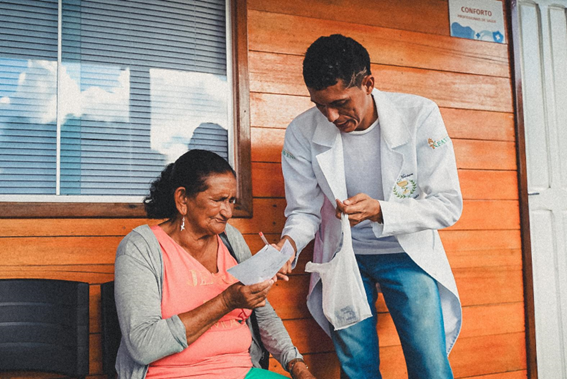
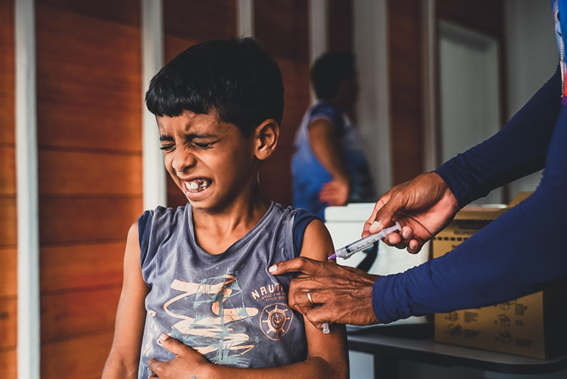
The medical center in Ubim is staffed full-time by a nursing technician, supported by community health agents working in the extractive reserve’s different communities. This team provides routine care, basic procedures, monitoring of chronic diseases, vaccination and coordination of teleconsultations. A physician, nurse and dentist travel to the region on periodic missions, staying for around two weeks every two months. Between missions, telehealth provides follow-up and remote consultations.
In the short term, the goal is to expand access to primary healthcare, reduce long journeys and ensure continuity of care, especially for pregnant women, children and people with chronic conditions. At the same time, the project connects with other actions under the Together Against Poverty program, in areas such as education, income generation through the social bioeconomy, food security and access to public policies, in order to support families in moving out of extreme poverty in the region.
Logistical barrier
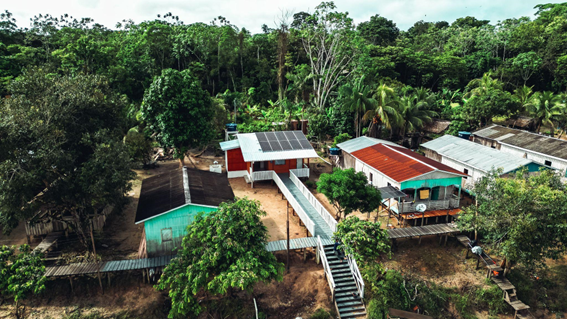
In the Rio Gregório Extractive Reserve, the first barrier appears on the map. To reach the town of Eirunepé, residents rely exclusively on river transport. From the village of Ubim, the journey to the town takes about eight hours by speedboat under normal high-water conditions. On the regional boats used by most of the population, the trip can take up to three days, and even longer during severe droughts, when sandbanks, logs and shallow stretches make navigation slower, unpredictable and, in some cases, impossible.
Getting to the healthcare center in Eirunepé is also costly. Transportation expenses, combined with food and possible overnight stays in the town, represent a significant burden for families whose income mainly comes from cassava growing, the gathering of forest products and region-specific programs. In practice, non-urgent consultations and tests are often postponed to the limit.
A snapshot of healthcare along the river
Before the new medical center was opened, healthcare in the Rio Gregório Extractive Reserve relied primarily on mobile teams from the Eirunepé Municipal Health Secretariat, especially the river-based primary care unit that periodically travels through the region. Although essential, these services typically took place only once every six months on average, making continuous care difficult.
Using the Together Against Poverty program’s Multidimensional Family Monitoring methodology, the Sustainable Amazon Foundation identified three critical deficiencies:
– Prenatal care: late initiation and insufficient number of consultations, with approximately 40% of pregnant women receiving what is considered adequate care. Geographic barriers, transportation limitations and seasonal river conditions hinder timely access, compromising early risk detection during pregnancy;
– Children’s health: irregular monitoring of growth and development, especially in early childhood, a stage when routine checkups and up-to-date vaccinations are crucial to preventing complications;
– Chronic diseases: presence of hypertension cases, with about 29 diagnosed individuals across the communities, who face difficulties in maintaining continuous control and regular access to medications.
Infrastructure for in-person and remote care
The new medical center was designed as a telehealth and primary healthcare hub adapted to the specific conditions of the Amazon. The facility includes a multiprofessional consultation room equipped for both in-person visits and teleconsultations. It provides basic medication dispensing and a triage room for registration, initial assessment, risk classification and patient flow management. There is also a waiting and circulation area, a dental office equipped for basic services and minor surgical procedures, a bedroom with a bathroom to accommodate health professionals during missions and an external restroom for patients.
In terms of technology, the center has internet connectivity and equipment for telemedicine, enabling teleconsultations and remote consultations with specialists. This connection allows professionals based in the town of Eirunepé to support care remotely, expanding the capacity to solve problems in Ubim.
Together Against Poverty: an integrated response to the challenges of extreme poverty
Together Against Poverty is a program led by Vale that aims to help 500,000 people move out of extreme poverty through a multidimensional approach. It developed the Multidimensional Family Monitoring methodology and tracks results using a Multidimensional Poverty Index created specifically for the program and validated by the University of Oxford. The goal is to identify deficiencies across five dimensions—income, education, health, nutrition and infrastructure—and support families in overcoming them through public policies and social programs available in each location. Currently, more than 60,000 people participate in the program in urban, rural and forest settings in five Brazilian states: Amazonas, Pará, Maranhão, Rio de Janeiro and Minas Gerais.
“Together Against Poverty was designed as a network of public and private partners working collectively to ensure that public policies effectively reach those who need them most. The methodology, built on a data-driven approach, prioritizes the agency of families living in extreme poverty and strengthens public policies based on the specific characteristics of each area. We know that poverty manifests itself very differently in urban, rural and forest settings, and we increasingly see that the best solutions emerge from within local communities, drawing on the knowledge of those who live there,” says Flavia Constant, Vale’s private social investment director.
In the Rio Gregório Extractive Reserve, the program is carried out in partnership with Fundo Vale. The work began in 2024 with around 247 families. Based on an initial diagnosis, a customized action plan was developed, including access to essential public welfare programs such as Cadastro Único and Bolsa Família, in partnership with local government bodies and civil society organizations.