
During a panel at COP30, the CERTI Foundation and partners presented advances, challenges and stories that are shaping a new innovation landscape in the Amazon
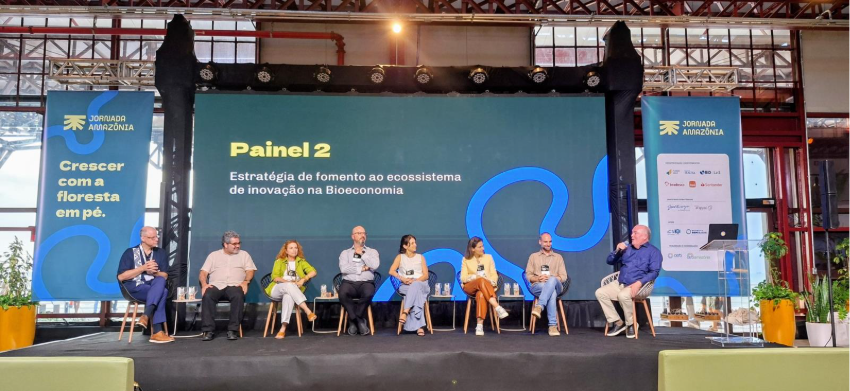
On an afternoon dedicated to strategies, results, lessons learned and inspiring stories from the Amazon Journey, the CERTI Foundation brought together experts and program partners at the Bioeconomy and Innovation Park in Belém to discuss the evolution of the bioeconomy innovation ecosystem, the connections needed to drive innovation and ways to strengthen this ecosystem. Fundo Vale – a partner of the CERTI Foundation in the program – took part in a panel called “Strategies to Promote the Innovation Ecosystem in the Bioeconomy.”
The Amazon Journey encourages innovative and impactful businesses in the region, focusing on the competitiveness of the bioeconomy, forest conservation and local social development, within an integrated support model. “In a context of economic transformation and innovation in the Amazon, the journey was born with boldness and courage to break with traditional models, overcome doubts about investments without immediate financial returns and bring to the region solutions that have already been tested in other socioeconomic realities,” explained Marcos Da-Ré, green economy director at the CERTI Foundation.
Fundo Vale Director Patrícia Daros highlighted the initiative’s role in building a more robust innovation ecosystem. “In 2018, we already understood that the forest is a powerful generator of wealth and that it was possible to support production chains that generate income for communities and protect the forest itself. We went to visit social and environmental impact businesses and realized that almost all of them were based in southeast Brazil. This revealed a fundamental gap: the Amazon and the broader forest and climate agenda were largely absent from that conversation,” she said.
According to her, this diagnosis led Fundo Vale to help structure the Amazon’s business ecosystem, connecting initiatives, avoiding the repetition of mistakes and strengthening social and biological diversity production chains. “The Amazon Journey doesn’t just generate business; it empowers people. More people come together, more connections are formed and more knowledge circulates. None of this was achieved in isolation. We often reminded ourselves that progress is not made alone but together, and this has transformed the real economy in many locations,” she said.
In leading the discussion, Da-Ré emphasized the systemic nature of the Amazon Journey and its commitment to supporting ventures throughout their entire trajectory. He pointed out that no single actor can offer everything a venture needs, but the combination of accelerators, investment firms, banks, philanthropy and public policies creates combined paths for startups to cross the “valley of death” and keep the forest standing.
Other participants reinforced this view. Silvana Rosa Machado, director of Bradesco, stressed the role of banks. “When we think about sustainability, we think about permanence. The role of banks is to provide capital and financing. We want to enable innovative products and solutions to advance this agenda, while making returns for ourselves and our partners,” she said.
Yuri Soares, head of impact at IDB Lab, underscored the innovative nature of the bioeconomy. “We have already financed more than 3,000 organizations across the region, but this wave is different. We saw the Amazon Journey as a real opportunity for transformation. We entered as a laboratory, testing instruments, and from there, we were able to scale up resources and coordination. What we learned here can inspire the entire Pan-Amazon region,” he said.
Leonardo Fleck, head of sustainability at Santander, highlighted the ecosystem’s change in scale. “In the beginning, we saw a fragile and fragmented ecosystem, with fewer than 300 startups. In three years, that number has grown to nearly 900. This changes the logic, by leading to network effects, value chains between businesses and more opportunities for scale. The challenge now is to secure a high survival rate and ensure that everyone makes money at the end of the day, including producers,” he said.
Marcelo Furtado, Itaúsa’s head of sustainability, shared the perspective of the real economy. “This is where critical mass is formed and the real economy happens. The bioeconomy applies knowledge to businesses that generate jobs, income and markets, while responding to climate challenges. Some of the solutions will not work, but mistakes feed the next cycle. What works will need investment, and we are here to learn how to translate these trajectories into investment returns,” he said.
Finally, Danielle Prioli, manager of geopolitical programs and modernities at UNESCO, reinforced the importance of recognizing the diversity of the “possible Amazons.” She said, “There are businesses created to serve the local community, with no intention of scaling up, which play a fundamental role and need different instruments from those aimed at startups with a venture capital profile. We need to deepen this taxonomy and adjust the support provided to each type of economy.”