
The Institute for Human Rights and Business (IHRB) published an in-depth article presenting agroforestry systems as a solution to keep forests standing, produce food and generate decent income for those who depend on the land
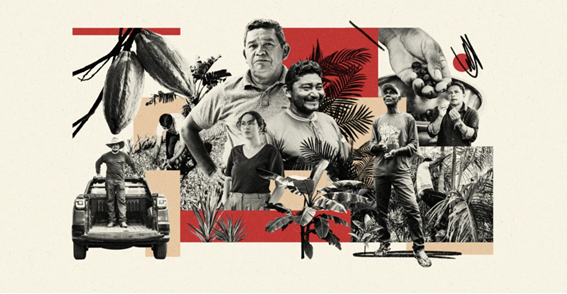
Image: JUST Stories
JUST Stories, the media platform of the Institute for Human Rights and Business (IHRB), recently published a comprehensive article on the just agricultural transition in Brazil, highlighting the work of Belterra and the catalytic role of Fundo Vale. IHRB’s platform aims to elevate, at a global level, stories of people and organizations working to advance just transitions. The initiative engages companies, investors, policymakers and civil society, reinforcing the understanding that human rights, climate action and rural development must move forward together.
By shining a spotlight on initiatives such as Belterra’s and on Fundo Vale’s technical and financial support, IHRB contributes to strengthening the international debate on the just transition in agriculture and demonstrates that sustainable land use business models are technically, socially and financially viable.
Agroforestry as a just climate solution in land use
The article presents the long-standing practice of agroforestry as a concrete solution to restore degraded soil, increase smallholders’ income and, at the same time, mitigate climate change.
Belterra, a partner of Fundo Vale, is portrayed as an impact business capable of combining technical expertise, innovative financing and productive inclusion. Working with small farmers and traditional communities, the organization restores areas, transforming them into productive Agroforestry Systems (AFS) that combine short-cycle and long-term crops, connecting this production to markets and new financial mechanisms, such as carbon credits.
The role of catalytic and patient capital in strengthening agroforestry systems in Brazil
Throughout the article, Fundo Vale is highlighted as one of the early supporters of Belterra’s vision: building a sustainable business model that combines land restoration, income generation and the strengthening of livelihoods for small farmers and traditional communities.
In the article, Director Patrícia Daros explains why Belterra stood out among dozens of businesses mapped by Fundo Vale: the company plays a strategic role in connecting farmers to markets by integrating agroforestry production, access to financing and links to buyers within a single model.
Daros notes that Belterra was identified as an initiative with strong potential to restore thousands of hectares of degraded land, aligned with long-term patient investment and built on a model that can be replicated across different regions. Her remarks reinforce Fundo Vale’s commitment to supporting businesses that, like Belterra, seek to combine scale, social and environmental impact and productive inclusion.
Juliana Vilhena, Fundo Vale’s strategy, management and impact manager, is also featured in the article, emphasizing the importance of philanthropic capital in enabling this transition. She explains that supporting businesses that restore land through productive models and expand regenerative agriculture requires catalytic capital. In the case of Belterra, this type of capital helps increase social and environmental impact, strengthen organizational resilience and provide the financial structure businesses need to grow, while also helping consolidate value chains.
In the case of Belterra, these resources contribute to increasing socio-environmental impact, strengthening organizational resilience, and financially structuring the business, while also helping to consolidate the value chain.
The article also aligns with Fundo Vale’s vision of promoting a just agricultural transition, in which farmers can remain on their land with greater autonomy and higher incomes. This transition also enables Quilombola, riverside and indigenous communities to actively participate in designing production systems suited to their realities, while encouraging companies to redesign their supply chains based on principles of regeneration and social and environmental justice.
The multiple benefits of agroforestry systems
Agroforestry is more than a production technique—it is a platform for local development. The article highlights the following positive social and environmental impacts:
Climate
- CO₂ sequestration, helping offset a share of global emissions
- Transforming emitting areas into potential carbon storage areas.
Environment
- Restoration of degraded soils, increased organic matter and improved nutrient cycling
- Water conservation, reduced erosion and protection of springs
- Increased biodiversity through the replacement of monocultures with complex species arrangements
Social and economic dimensions
- Diversification of income sources, reducing the vulnerability of farming families
- Creation of skilled jobs in rural areas, including opportunities for young people, technicians and local extension agents
- Strengthening of community organizations, cooperatives and associations
- Contribution to local food security through greater diversity of food production
Read the full article.