
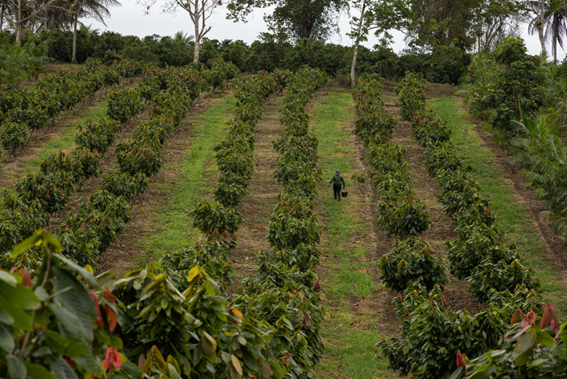
Photo: Renato Stockler
Backed by an equity round of up to R$75 million and continued support from Fundo Vale through Vale’s 2030 Forest Goal in business structuring, financial consolidation, and impact strategy, the company is strengthening its governance and expanding its production capacity in agroforestry systems.
Using cocoa as its main driver of development in agroforestry systems, Belterra Agroflorestas is expanding its operations after six years of technical, operational and financial validation. The company is entering a new phase of growth, supported by a more robust financial structure, greater execution capacity and the completion of an equity round of up to R$75 million, aimed at preparing the business to scale up sustainable cocoa production in agroforestry systems.
The move includes what the company describes as the first equity investment in a vertically integrated agroforestry production operation, marking a new stage of maturity for the model.
Fundo Vale supported its creation and invested seed capital in the company. Since 2020, it has supported the business through a blended finance strategy that uses catalytic capital as leverage to support the company throughout its growth, in the context of Vale’s 2030 Forest Goal. Belterra currently operates approximately 2,500 hectares of agroforestry systems under contract in the Amazon Rainforest and Atlantic Forest biomes, through projects in the states of Pará, Mato Grosso, Rondônia and Bahia.
“In a context where many producers face limited access to traditional rural credit, the blended finance strategy has been decisive in ensuring that the capital structure is in place before the systems are implemented, reducing risks, attracting new investors and reinforcing the investment thesis of an agroforestry platform with significant social and environmental impact and long-term returns,” says Patrícia Daros, Fundo Vale’s director.
“After six years building the technical, operational and financial foundations of its model, Belterra has reached a moment of growth with confidence in the path ahead. The challenge now is to scale up with discipline, and we have the structure and partners to do so,” says Marcelo Pereti, chief financial officer of Belterra Agroflorestas.
Capital structure, new SPVs and stronger governance
The Series A round is led by Bold.t and includes participation from MOV Investimentos, Rise and Ecosia, a group of impact investors focused on sustainable finance, climate transition, environmental restoration and businesses with positive social and environmental impacts.
The investment is directed to Belterra’s holding company and culminates in a redesign of the company’s structure: projects will now be organized into different special purpose vehicles (SPVs), grouped under the parent company. This model makes it possible to structure each SPV according to the profile and motivation of investors, combining cocoa, other crops compatible with biodiverse systems and carbon credits.
In the first SPV, which brings together the approximately 2,500 hectares already under implementation, Belterra invested R$30 million in proprietary projects, financed primarily through the Climate Fund, managed by the Brazilian Development Bank (BNDES), and the Amazon Biodiversity Fund (ABF), managed by Impact Earth, reaching a total value of R$155 million. The areas will also be counted toward Vale’s 2030 Forest Goal, and Fundo Vale’s financial and non-financial support was also important for consolidating this new capital structure.
Over the coming years, Belterra plans to attract new investments in the restoration of areas using productive agroforestry systems, with plans for future SPVs that could reach areas of up to 20,000 hectares. The newly announced investment will not be directed specifically toward setting up these SPVs, but will be essential for enabling the holding company to provide them with the necessary structure in terms of finance, management, technology, logistics and people, supporting projects distributed across different regions of the country.
At the same time, Belterra has strengthened its governance through the creation of a more active board and the adoption of management, controllership and financial reporting structures aligned with the company’s new stage of development. The arrival of new partners reinforces this movement, raising the level of oversight and expectations in terms of transparency and management discipline.
Expansion of production and infrastructure
As part of its growth strategy, Belterra aims to reach annual production of 37,500 metric tons of cocoa by 2035, in a global context marked by declining supply in traditional production regions. To support this expansion, the holding company’s infrastructure is being strengthened through management systems, finance, technology and an operations structure capable of supporting teams distributed across multiple states. In addition, Belterra is hiring leaders with agribusiness experience to coordinate field operations.
Investment in nurseries is one of the pillars of this growth. Today, Belterra produces just over 1 million cocoa seedlings per year and already has the installed capacity to reach 2 million. The company is establishing a new nursery that will enable production to reach approximately 3 million seedlings annually over the coming years, in a market that remains relatively underdeveloped in terms of cocoa seedling supply.
Agroforestry platform
The company positions itself as an agroforestry platform, using cocoa as its current main development driver, combined with a diversity of productive and forest species that make up agroforestry systems, as well as carbon credit generation. The model operates within a significant global market marked by structural supply challenges, growing pressure for traceability and sustainability, and increased exposure of agricultural production to extreme weather events.
“In this context, demand is growing for more resilient production systems capable of combining agricultural productivity, environmental regeneration and reduced climate-related production risks. By integrating different species within the same system, agroforestry systems contribute to greater soil protection, improved water retention, microclimate regulation and diversified revenue streams over time. The model was designed to enable this diversification through the incorporation of other commodities compatible with biodiverse systems,” explains Valmir Ortega, chief executive officer of Belterra.
Social and environmental impact
The expansion of operations is expected to have a direct impact on the regional economy, creating around 1,500 direct jobs and more than 1,000 indirect jobs throughout the production chain. On the environmental front, the company estimates it will capture approximately 500,000 metric tons of carbon by 2030, considering the initial phase of implementation and growth of areas. Over a 30-year horizon, total carbon capture is expected to reach 4.5 million metric tons, underscoring the model’s potential as a nature-based solution for climate change mitigation.
About Vale’s 2030 Forest Goal
Vale’s 2030 Forest Goal is the company’s voluntary commitment to protect and restore 500,000 hectares beyond legal requirements and beyond its operational boundaries by the end of the decade. The initiative is a response to the climate emergency and is aligned with another company target: achieving carbon neutrality by 2050.
Implementation is led by Fundo Vale, the Natural Resources and Protected Areas Department (GRNAP), and the Climate Change area, with support from the Vale Institute of Technology (ITV) and a broad network of partners. The initiative involves public-private partnerships, is aligned with national and international sustainability agendas, and has the potential to inspire a benchmark model for the private sector in voluntary actions capable of generating concrete benefits for nature and people at scale.
All actions are carried out with transparency, based on data and evidence, and are designed to ensure the longevity of positive impacts beyond 2030.