
Meetings addressed the progress of Vale’s voluntary commitment and the role of agroforestry systems in building a new forest economy
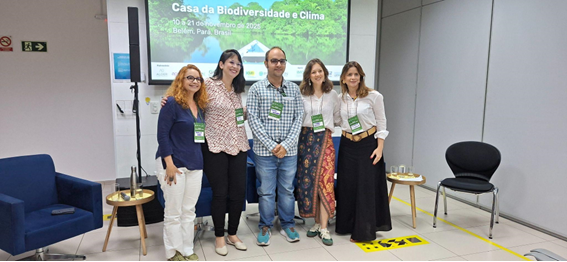
During COP30, the Biodiversity and Climate House, an initiative led by the Brazilian Association of State Environmental Agencies (ABEMA) in partnership with the Sustainable Development branch of the Vale Institute of Technology (ITV DS), hosted two panels moderated by Juliana Vilhena, Fundo Vale’s strategy, management and impact manager. Focusing on nature-based solutions, building a new forest economy, scientific collaboration and habitat protection strategies, the meetings brought together government bodies, companies, researchers and impact businesses.
Five years of Vale’s 2030 Forest Goal
The first panel presented the trajectory of Vale’s 2030 Forest Goal and the lessons learned during its first five years of implementation. Created in 2019, this initiative was born out of a commitment to protect and/or restore 500,000 hectares of forests outside the company’s operational sites. This voluntary action has become a milestone of additionality on Vale’s climate, biodiversity and sustainable local development agenda and is associated with another of the company’s goals: to become carbon neutral by 2050.
Over the past five years, Vale’s 2030 Forest Goal has become one of Brazil’s most robust corporate initiatives for environmental recovery and protection, reaching around 43% of its target or roughly 215,000 hectares. Beyond the headline numbers, the initiative’s trajectory reflects a new model of corporate action focused on generating positive, lasting social and environmental impacts. It brings together innovative financial instruments and strategic partnerships with sustainable businesses, civil society organizations, government environmental agencies and the scientific community.
According to Patrícia Daros, Fundo Vale director, the initiative represents a step change in the company’s operations. “The Forest Goal is not a legal obligation; it is a choice to do more. It is not just about offsetting impacts but about creating value, ensuring that preserved forests are worth more than felled forests,” she said. She emphasized the collaborative nature of the agenda: “The Forest Goal brings together diverse actors and perspectives. Coordinating all these partners is enormously complex, but this broad collaboration is precisely what makes the difference.”
Thaís Volpe of the Espírito Santo State Environmental and Water Resources Agency (IEMA) commented on Vale’s support for conservation areas within the scope of the 2030 Forest Goal’s protection component, which includes donations of equipment and services, as well as support for management activities. According to her, the difference lies in the approach to the surrounding communities. “Those who live near conservation areas often only see the restrictions. When they understand that the forest guarantees the water that irrigates their crops and protects the region’s springs, their perception changes completely,” she said. She also stressed the role of environmental education: “Science that never reaches the ground ends up as nothing more than an academic article; when it enters schools and communities, it reshapes how local people understand themselves.”
From the perspective of technical and financial support for impact businesses, Isabel Britez from Belterra presented advances in productive restoration supported by Fundo Vale, including almost 4,000 hectares of agroforestry systems implemented in partnership with rural producers. “What we do has already been proven to work. The next step is to strengthen an entire ecosystem of productive restoration, with many initiatives working at the same time to gain scale,” she said.
On the science side, the Vale Institute of Technology (ITV) has been developing indicators and methodologies to monitor the effects of the Forest Goal in areas restored through sustainable systems such as agroforestry. Researcher Rafael Valadares explained that soil health has been used as one of the main indicators of restoration quality. “Healthy soil produces food, generates income, sequesters carbon and is more resilient to extreme weather. If the soil improves, it means that land management is on the right track,” he said.
When assessing the results achieved by Vale’s voluntary commitment, Patrícia Daros stated, “What we have learned is that there is no single path, but a mosaic of solutions. The role of the Forest Goal is to test, learn and share what works, so that other initiatives can go further and faster. In five years, we have already been able to show that it is possible to restore and protect large areas while generating jobs and income. Brazil has everything it needs to be a global leader in nature-based solutions. When we bring together science, communities, business and public management around a common purpose, forests become a strategic asset for the country’s future,” she concluded.
According to the Fundo Vale director, the next cycle of the 2030 Forest Goal is set to deepen the monitoring of results for climate, biodiversity and communities, while expanding the scale of action.
Agroforestry systems and the new standing forest economy
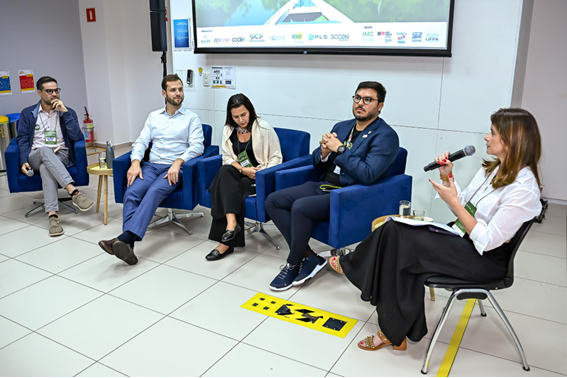
The second panel, focused on agroforestry systems and their contribution to tackling climate change, brought together Philip Kauders from Courageous Land, Sâmia Nunes from ITV, Eduardo Rocha from the Partners for the Amazon platform and Acre State Environment Secretary Leonardo Carvalho. The participants emphasized that agroforestry systems combine food production, environmental recovery and income generation, providing an integrated solution to challenges in rural areas.
“Brazil has a goal of restoring 12 million hectares of native vegetation, including 9 million hectares in legally mandated minimum areas of native habitat. One of the solutions is precisely the use of agroforestry systems, which help to restore vegetation, soil and biodiversity while generating production,” said Juliana Vilhena.
Courageous Land, a Fundo Vale partner under Vale’s 2030 Forest Goal, is working to accelerate the productive transition through the large-scale implementation of agroforestry systems in conjunction with farmers and local communities, offering technical assistance, business models and innovative financing mechanisms. In practice, this translates into the conversion of areas into biodiverse agroforestry systems, featuring multiple species, different production cycles and greater climate resilience.
According to Kauders, the partnership with Fundo Vale is helping to scale up these actions and directly connect results in the field with climate and biodiversity goals. In his view, agroforestry systems represent a concrete and economically viable response: “Agroforestry is nothing more than trees in agricultural landscapes, and it is an elegant solution to several problems at the same time – a very complete solution.”
Sâmia Nunes, a researcher at ITV, highlighted the contribution of applied science to unlocking the adoption of agroforestry systems. The institute has been developing technical materials in accessible language that help farmers better understand the implementation costs, long-term economic viability and environmental benefits of agroforestry systems. This content covers everything from agroforestry design planning and harvest schedules to the role of agroforestry systems in soil recovery, increasing biodiversity and generating additional income.
Eduardo Rocha from the Partners for the Amazon platform reinforced the role of agroforestry systems in structuring social and biological diversity production chains and in climate adaptation in Amazonian locations. He presented the platform as a network that brings together different sectors around regional development and the strengthening of impact businesses. According to him, well-designed agroforestry systems help reduce vulnerabilities, diversify production and generate economic opportunities, provided they are embedded in an ecosystem of partnerships and trust between communities, companies, government bodies and civil society organizations.
Representing the public sector, the Acre environment secretary, Leonardo Carvalho, shared the state’s experience in implementing agroforestry systems in degraded areas. He presented the results of programs that combine technical support, seedling supply and financial incentives linked to forest restoration through agroforestry systems. Carvalho reported cases in which producers, initially resistant, began to adopt agroforestry systems after observing concrete gains in income and improvements in the landscape, including in critical areas of deforestation.
Together, the contributions of Courageous Land, ITV, the Partners for the Amazon platform and the state government of Acre reinforced the message that agroforestry systems are a systemic axis of the new forest economy, integrating scientific knowledge, innovation in business models, public policies and the leadership of local communities.