
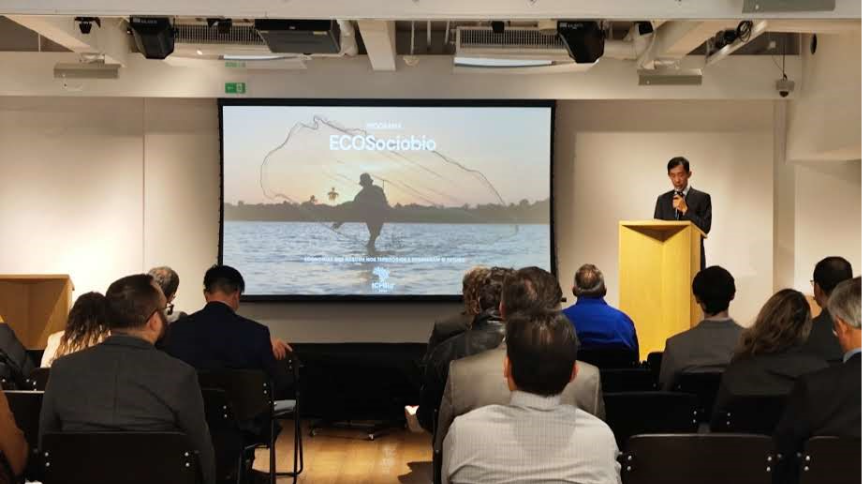
A recent event at Japan House São Paulo introduced the private sector to the ECOASociobio program, a strategy developed by the Chico Mendes Institute for Biodiversity Conservation (ICMBio) to strengthen social and biological diversity-based economies in federal conservation areas. Inspired by the experience of Sustenta.Bio, a Fundo Vale program carried out in partnership with ICMBio since 2023, the new program will expand integrated solutions across a broader geographic area, connecting conservation, income generation and the empowerment of traditional communities.
The event, organized by ICMBio and the Japanese embassy in Brazil, with support from Fundo Vale, brought together Mauro Pires, president of ICMBio; Tomoaki Ishigaki, minister and deputy chief of mission at the Japanese embassy in Brazil; and Carlos Roza, president of Japan House São Paulo, along with Japanese business leaders, partner institutions and representatives of traditional communities. Tatiana Rehder, ICMBio’s general coordinator for public policy coordination and social and biological diversity economies, presented the ECOASociobio program’s guidelines, while Márcia Soares of Fundo Vale’s Amazon and Partnerships Area shared lessons learned from Sustenta.Bio.
“Sustenta.Bio is recognized as a successful example of building bridges between traditional knowledge, civil society organizations’ solutions and the market. The program demonstrates that each social and biological diversity value chain has its own pace and that scaling impact requires coordinated governance, community leadership and metrics that clearly demonstrate what works,” said Soares.
Sustenta.Bio currently supports 15 protected areas in the Amazon, focusing on strengthening social and biological diversity value chains for products such as pirarucu fish, Brazil nuts, açaí and vegetable oils. The program works to strengthen the governance of organizations, cooperatives and associations, improve infrastructure, provide technical capacity building and expand market access for local products. ECOASociobio, formally established through ICMBio Ordinance 163 of 2026, has a nationwide scope and will coordinate similar initiatives across the entire federal system of conservation areas, which comprises 347 areas covering 171.8 million hectares and involving around 100,000 families of Indigenous Peoples and traditional communities.