
Panel took place during “Philanthropy Day,” a COP30 side event organized by the Charities Aid Foundation, GIFE, IDIS, Sitawi Finanças do Bem, Latimpacto and WINGS
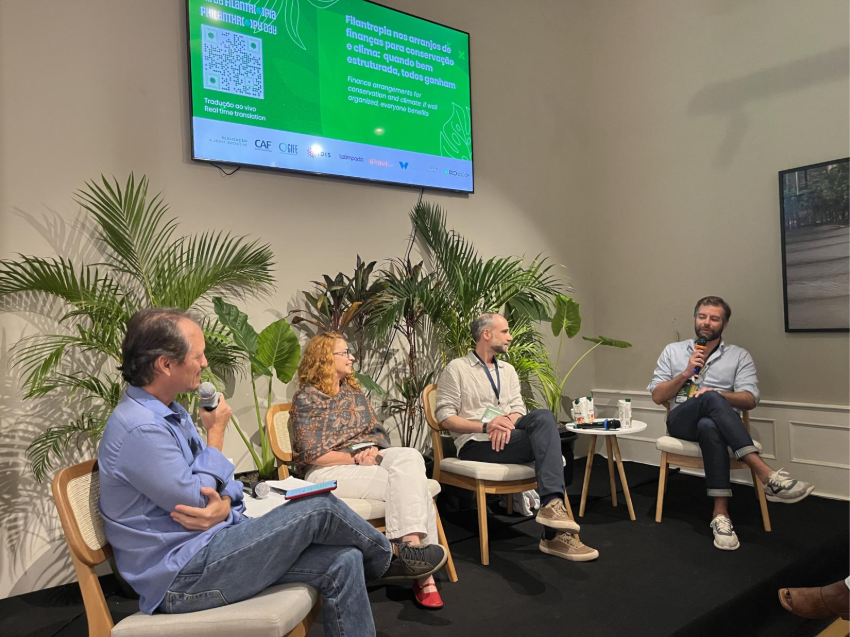
In an afternoon devoted to reflecting on the role of philanthropic capital in the face of the climate emergency and social inequalities in Brazil, around 150 people gathered at Casa Balaio in Belém for a COP30 side event called Philanthropy Day. During a panel titled “Financial arrangements for conservation and climate: Organizing things right benefits everyone,” moderated by Leonardo Letelier, CEO of Sitawi Finanças do Bem, the discussion focused on the challenges and lessons learned from using hybrid financial mechanisms to foster sustainable businesses in the Amazon.
Letelier invited the panelists to reveal what happens “behind the scenes,” looking not only at success stories but also at the obstacles to scaling up social and environmental impact. During the discussion, Patrícia Daros, Fundo Vale director, emphasized the importance of philanthropy while also pointing to regulatory barriers and the slow pace of other investment flows.
Daros presented the trajectory of Fundo Vale, which has been operating in the Amazon for 16 years. It has been shifting from traditional philanthropy to supporting social and environmental impact businesses, positioning its resources as catalytic capital to strengthen business operations and their value chains. One of the organization’s objectives is to attract other investors to enable these ventures to grow.
“Private capital falls far short of what is needed. Fundo Vale enters first, takes on more risk and places capital in the subordinated tranche precisely to attract other resources and amplify the impact – but that capital often still does not come. The problem is that many investors are still averse to forest-based businesses, which require patience and a willingness to deal with operational and climate risks,” she said.
Pedro Hartung, CEO of Alana, shared the organization’s approach, which integrates philanthropy, advocacy and communication to promote the rights of children, adolescents and nature through systemic investment. “To change something, you can’t use just one tool. You have to build a coalition of people, tools, organizations and themes,” he said, arguing that philanthropy should “take the risk, test and show that it is possible to do things differently, building infrastructure that can later be used by other actors.”
The discussion converged on the need to strengthen investments with a focus on local communities, ethics and collaboration, reinforcing that philanthropy is at the forefront of building new financial pathways for the Amazon. At the same time, the panelists agreed that this work will only scale up if a broader investment ecosystem emerges.
About Philanthropy Day at COP30
Organized by the Charities Aid Foundation, GIFE, the Institute for the Development of Social Investment (IDIS), Sitawi Finanças do Bem, Latimpacto and WINGS, the event brought together representatives of civil society organizations, social investors, networks and initiatives from the Amazon and other regions of Brazil. The program featured three panels with national and international experts, including Mark Greer of the Charities Aid Foundation and Anthea McLaughlin of the Caribbean Philanthropic Alliance. There was also a “Local Voices” segment with Rose Meire Apurinã from the Podáali Fund and Francisca Gárdina Lima from Instituto Baixada.
The debates explored how philanthropy can be a strategic lever for tackling poverty, expanding access to healthcare and education and protecting rights, linking these agendas to the climate emergency and the central role of the Amazon. Throughout the discussions, the participants stressed that simply increasing resources is not enough: it is essential to improve how investments are made, with a focus on long-term impact, strengthening local organizations, respecting traditional knowledge and promoting community autonomy.
Transparency, measurement of results, knowledge sharing and collaboration between organizations emerged as key themes, along with the defense of common agendas, clear goals and space for social innovation and public policy advocacy. According to Paula Fabiani, CEO of IDIS, the meeting highlighted “the enormous potential of knowledge sharing and networks” and showed that although much remains to be done, there are countless opportunities for progress.