
Panel featuring Fundo Vale shows that democratizing investment requires new models for risk, return and timelines, along with coordination among philanthropic funds, venture capital, digital microcredit and even peer-to-peer lending to scale up solutions
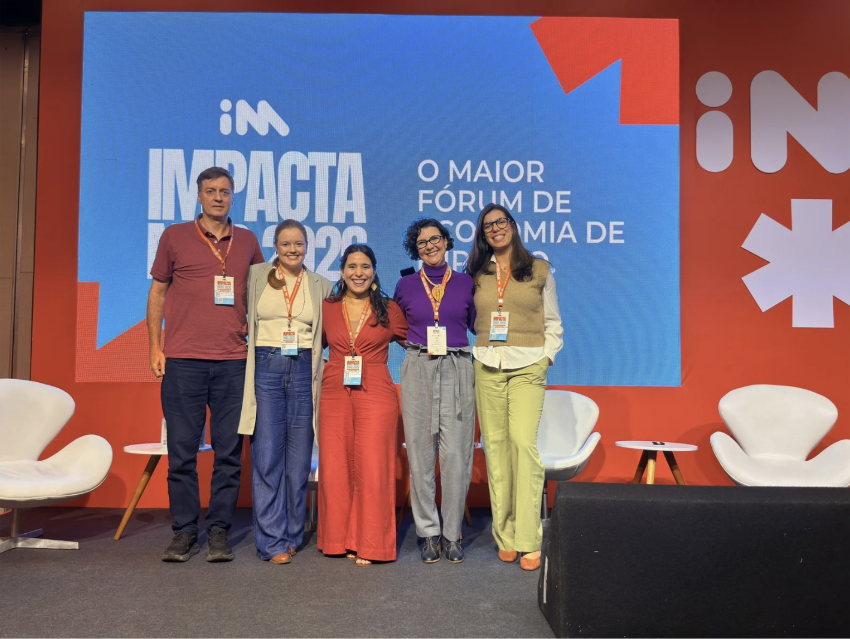
Impacta Mais 2026, the Brazilian Impact Business Investment Ecosystem Forum, reached its sixth and largest edition yet, cementing its role as a strategic space for strengthening the impact ecosystem. Held on May 20 and 21 in São Paulo, the event brought together investors, companies, government bodies, institutes, foundations, entrepreneurs, universities and regional leaders, totaling approximately 1,700 registered participants for two days of meaningful connections and discussions on pathways toward real solutions to the country’s social, environmental and productive challenges.
Democratizing impact investing
The panel “Democratizing Impact Investing” raised a central question: what does it mean to talk about impact if capital continues to operate under the same rules as the traditional market?
Moderated by Juliana Telles of Impact Hub, the discussion brought together Márcia Soares of Fundo Vale, Luiza Diógenes of Vox Capital, Alessandra de França of Banco Pérola and Marcos Pugotti of the Employment, Investment and Social Impact Association to show that democratization is not only about distributing resources, but also about changing the logic governing how they circulate. The panelists discussed the main barriers to democratization, including the lack of financial and impact education, the difficulty of scaling up long-term restoration bioeconomy businesses, the absence of coordination and central public policies, and the gap between awareness and action when it comes to moving money out of secure investments and toward impact entrepreneurs.
“When we talk about democratization, we think about the different groups working on the conservation and restoration agenda. We see democratization as encompassing everything from the formation of associations and cooperatives at the base of value chains that keep the forest standing to catalyst organizations and businesses operating at scale,” said Márcia Soares, Fundo Vale’s Amazon and partnerships manager.
Innovative solutions
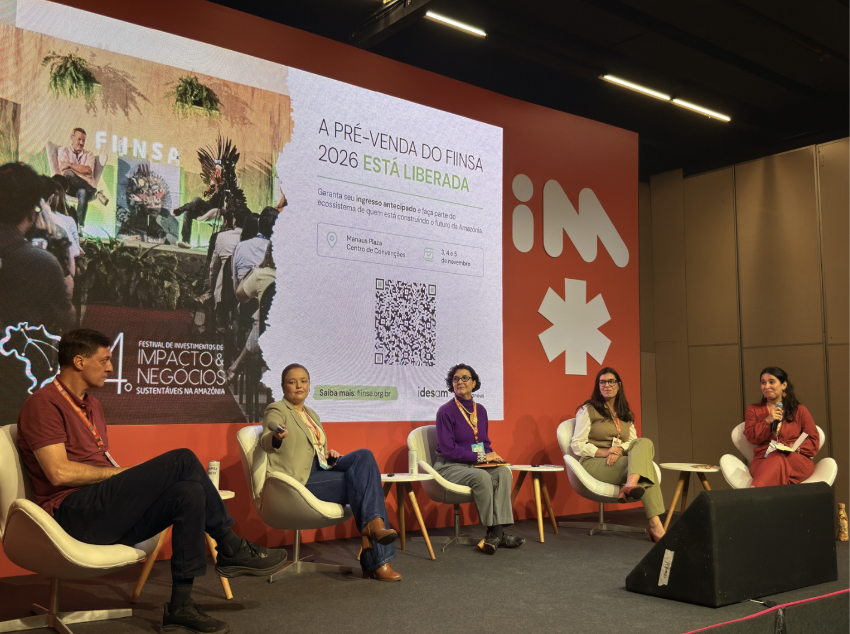
A key theme throughout the discussion was the idea that simply replicating the logic of traditional markets is not enough: financial instruments and relationships must be designed around a transformative purpose. As Márcia Soares summarized, the challenge is that if we continue operating under conventional rules, we will merely claim to create impact while following the same market logic in businesses that require a different approach to risk, return and timelines.
Among the practical solutions discussed, Vox Capital spoke about expanding beyond venture capital into fixed-income funds accessible from investments as low as R$100, while maintaining a commitment to entrepreneur diversity. Banco Pérola positions itself as a digital bridge between impact investors and microentrepreneurs who would never pass the screening process of traditional banks. The Employment, Investment and Social Impact Association has created a peer-to-peer lending system starting at R$10 as a tool to develop “citizen investors.” Meanwhile, Fundo Vale has established itself as a “laboratory” using flexible philanthropic capital to unlock public, market-rate and concessional funding in support of forests and climate initiatives.
The “art of gathering” as a driver of the impact economy
Over the course of two days, Impacta Mais 2026 celebrated a growing impact ecosystem. Through thematic hubs, simultaneous stages, a business fair, networking sessions, regional spaces, awards and experimental environments, the event highlighted the strength of an agenda supported by Brazil’s recently renewed National Strategy for Impact Investments and Businesses and by the leadership of civil society.
The program was organized around seven thematic hubs, including the Sustainable Value Chains and Circular Economy hub, sponsored by Fundo Vale, which focused on solutions to make value chains more efficient, responsible and regenerative.
The “art of gathering” was reaffirmed as a driving force behind the impact economy, and the message was clear: it is up to this community to make the country a leader in terms of an economic model that benefits both people and the environment, working today to build the results we hope to look back on with pride 20 years from now.
“Despite all the challenges we face, today we have a larger and more comprehensive ecosystem. This event alone is a sign of that expansion: there were 1,700 registrations, more than last year and more than in any previous edition of Impacta Mais,” celebrated Paulo Handl, cofounder and partner at Impact Hub São Paulo. “We now have a renewed National Strategy for Impact Investments and Businesses that has been established as an official national public policy and strategy, giving scale and strength to the field,” he added.