Comprising two main objectives — restoring 100,000 hectares and protecting 400,000 hectares outside its operational sites by the end of the decade — Vale’s 2030 Forest Goal is among the most ambitious voluntary sustainability commitments in the mining sector.
The initiative is part of a set of six goals aligned with the UN’s 2030 Agenda established by Vale in 2019. It supports the company’s goal of achieving carbon neutrality by 2050 and represents a concrete response to the global climate emergency.

The strategy to protect 400,000 hectares is led by Vale Natural Reserve, while the goal of restoring 100,000 hectares is managed by Fundo Vale.

Strategy for restoring 100,000 hectares

Fundo Vale’s strategy for restoring 100,000 hectares of habitat by 2030 is based on an innovative approach and guided by its Theory of Change:

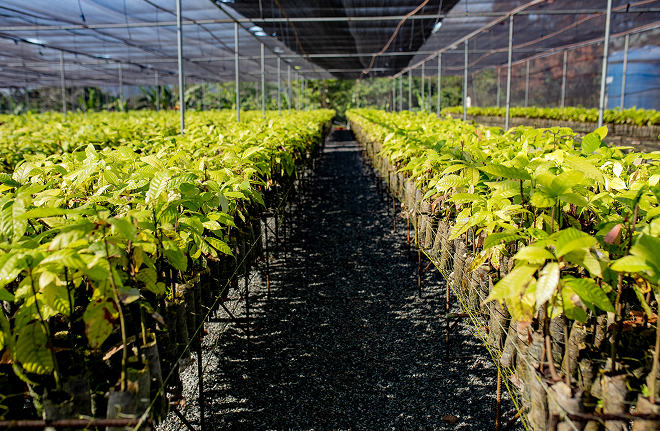
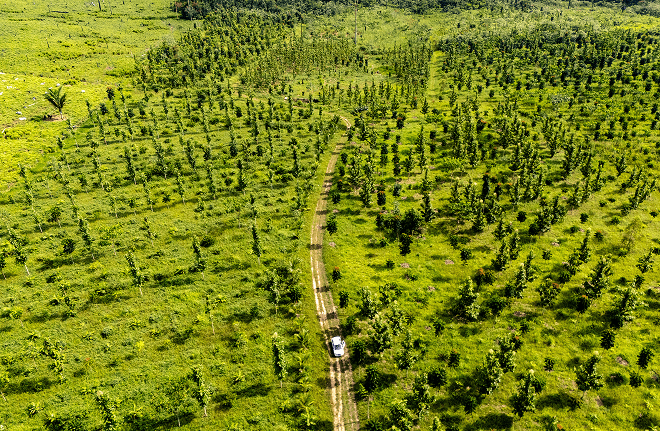
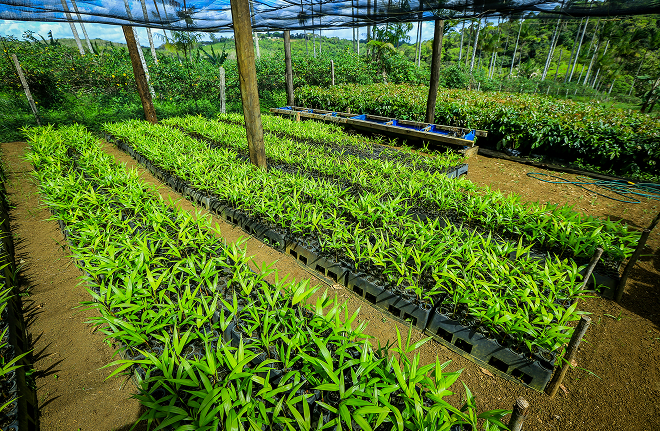
    1. Mapping, selecting and supporting startups and companies that seek to accelerate and promote the scaling up of businesses based on sustainable systems, such as agroforestry, integrated crop-livestock-forest systems, diversified forestry, assisted natural regeneration, and fruit growing;
    2. Connecting with investors and developing blended finance models to facilitate access to capital and reduce risks;
    3. Facilitating strategic value chain agreements, connecting with offtakers (buyers) and anticipating revenues.

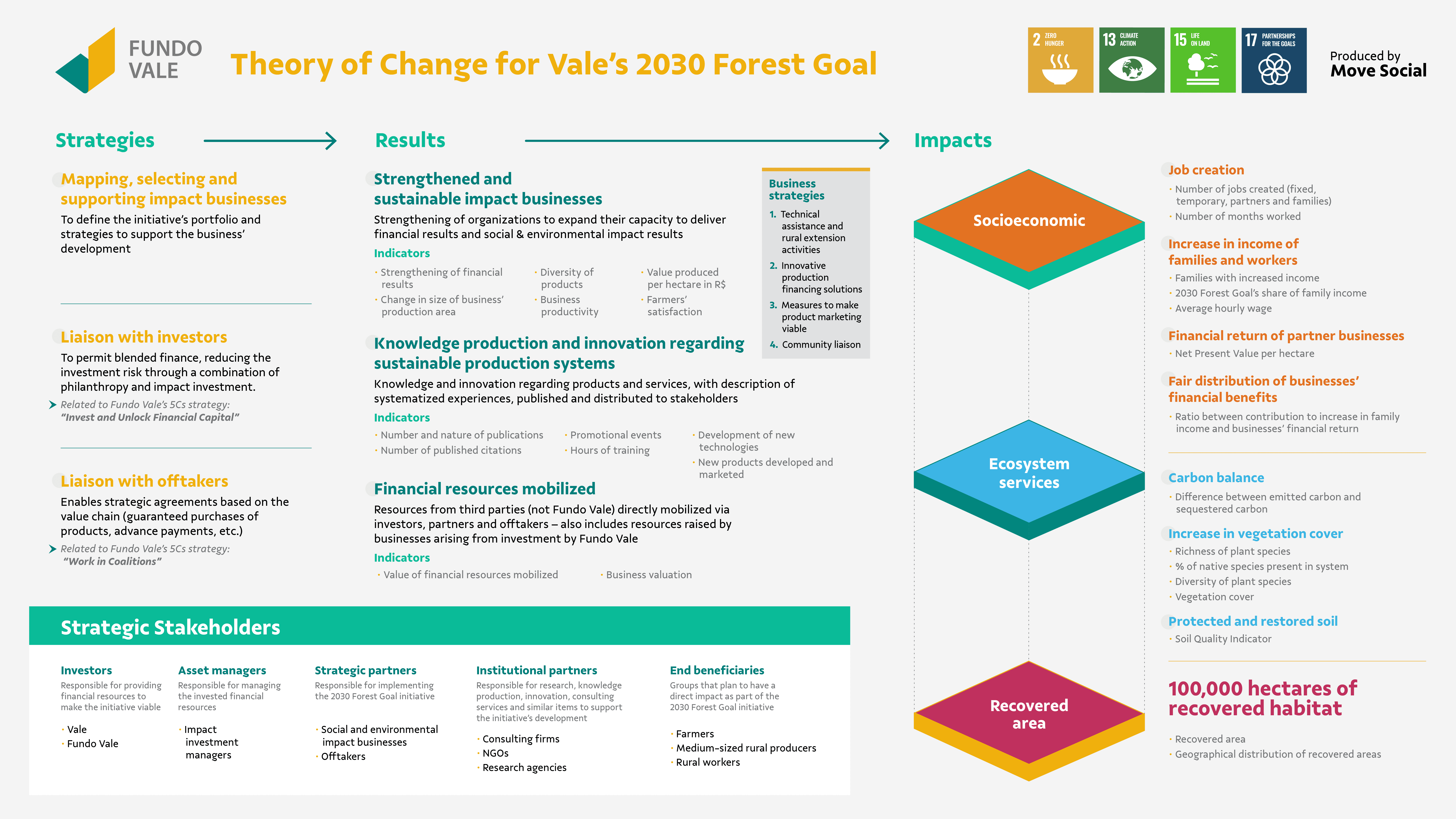
Theory of Change for Vale’s 2030 Forest Goal

Mapping, selecting and supporting impact businesses

To define the initiative’s portfolio and strategies for fostering the development of enterprises

Engaging investors

To enable blended finance mechanisms that reduce investment risks through a combination of philanthropy and impact investment

  • Aligned with Fundo Vale’s 5Cs strategy: “to invest and unlock financial capital”

Engaging offtakers

To facilitate strategic agreements across value chains (involving product purchase guarantees, revenue advances and similar mechanisms)

  • Aligned with Fundo Vale’s 5Cs strategy: “to work in coalitions”

Stronger and sustainable impact businesses

Strengthening of organizations to enhance their capacity to deliver financial, social and environmental results

Indicators
  • Stronger financial results
  • Changes in production systems
  • Product diversity
  • Monetary value produced per hectare
  • Business sustainability
  • Business productivity
Business strategies
  1. Technical assistance and rural extension activities
  2. Innovative solutions for financing production
  3. Measures to enable the commercialization of products

Knowledge generation and innovation regarding sustainable production systems

Knowledge and innovation involving products and services, with descriptions of experiences that are systematized, published and distributed to internal and external audiences

Indicators
  • Number of articles and publications
  • Number of case studies and publications
  • Development of new technologies
  • Number of promotional and commercial publications
  • Data and information managementEventos de divulgação

Financial resources mobilized

Funds raised from third parties (beyond Fundo Vale) directly through partner investors and offtakers, including complementary resources leveraged through Fundo Vale’s investments

Indicators
  • Amount of financial resources mobilized
  • Business feasibility

Socioeconomic

Job creation
  • Number of jobs created (permanent, temporary, partners and families)
  • Number of months worked
Increase in income of households and workers
  • Number of families with increased income
  • Share of household income contributed by 2030 Forest Goal initiatives
  • Average hourly wage
Financial return of partner businesses
  • Net Present Value (NPV) per hectare
Fair distribution of business’ financial benefits
  • Ratio between contribution to household income growth and business’s financial returns

Ecosystem services

Carbon balance
  • Difference between carbon emitted and carbon sequestered
Increase in vegetation cover
  • Richness of plant species
  • Percentage of native species present in the system
  • Diversity of plant species
  • Vegetation cover
Protected and restored soil
  • Soil quality indicator

Restored areas

100,000 hectares of restored areas
  • Total restored area
  • Geographic distribution of restored areas

Investors

Responsible for providing financial resources to make the initiative viable

  • Vale
  • Fundo Vale

Asset managers

Responsible for managing the invested financial resources

  • Impact investment managers

Strategic partners

Responsible for implementing the 2030 Forest Goal initiative

  • Social and environmental impact businesses
  • Off takers

Institutional partners

Responsible for research, knowledge production, innovation, consulting services and similar activities that support the initiative’s development

  • Consulting firms
  • NGOs
  • Research agencies

Final beneficiaries

Groups directly benefiting from the 2030 Forest Goal initiative

  • Farmers
  • Medium-sized rural producers
  • Rural workers
Download

Impacts

Environmental

  • Increased carbon sequestration
  • Expanded vegetation cover
  • Soil protection and restoration
  • Reintroduction of native species
  • Protection and restoration of biodiversity

Socioeconomic

  • Job creation and increased income for families in the community
  • Financial return for partner businesses
  • Positive Net Present Value (NPV) per hectare
  • Fair distribution of benefits

Portfolio

Our portfolio includes businesses such as:

Belterra Agroflorestas
Caaporã Agrosilvipastoril
Inocas
Regenera
Bioenergia Orgânicos com realização de Provas de Conceito (POCs)
Radix Investimentos
Cooperativa Agrícola Mista de Tomé-Açu (CAMTA)
Futuro Agroflorestal
Couregous Land
Strategy for protecting 400,000 hectares

Managed by Vale Natural Reserve and Vale’s Nature-Based Solutions Department, the strategy to protect 400,000 hectares by 2030 involves partnerships with environmental agencies to support Conservation Areas in high-priority regions selected using social, environmental and economic criteria. This integrated approach allows us to:

  • protect critical habitats;
  • monitor biodiversity;
  • strengthen participatory management;
  • generate sustainable income opportunities for surrounding communities.

This strategy directly supports the Global Biodiversity Framework, which aims to protect 30% of the world’s natural areas by 2030.

Protected areas

1.423,96

protected hectares

Goytacazes National Forest (ICMBio)

Linhares/ES

10.458,90

protected hectares

Serra das Torres State Natural Monument (IEMA)

Atílio Vivácqua, Mimoso do Sul e Muqui/ES

2.910,00

protected hectares

Duas Bocas Biological Reserve (IEMA)

Cariacica, Viana e Santa Leopoldina/ES

38.053,00

protected hectares

Cunhambebe State Park (INEA)

Angra dos Reis, Mangaratiba, Rio Claro e Itaguaí/RJ.

3.598,41

protected hectares

Augusto Ruschi Biological Reserve (ICMBio)

Santa Teresa/ES

50.892,39

protected hectares

Mata Escura Biological Reserve (ICMBio)

Jequitinhonha e Almenara/MG

7.756,76

protected hectares

União Biological Reserve (ICMBio)

Casimiro de Abreu, Macaé e Rio das Ostras/RJ

Amount invested in cooperation initiatives with Conservation Areas

R$33.5 million

Figures from 2020 to 2024

Total area protected through partnerships with Conservation Areas

115,000 hectares

Figures from 2020 to 2024

Total area protected through REDD+ project

85,000 hectares

Environmental education training sessions held

+1.350

Figures from 2020 to 2024

Donations

>40,000 items of equipment donated

*Drones, cameras and firefighting equipment

Social and environmental impact

>365,000 people engaged

*In environmental education training and initiatives

Figures from 2020 to 2024

Impact carbon

The strategy for generating impact carbon credits under the 2030 Forest Goal combines environmental conservation with social development, promoting forest protection while providing direct benefits to local communities.


Through this approach, Fundo Vale has established a partnership with the Algar Group, involving a Reducing Emissions from Deforestation and Forest Degradation (REDD+) project carried out at Fazenda Pacajá, a large property in northern Pará.


This project has dual certifications, from the Verified Carbon Standard (VCS) – an international benchmark for carbon measurement quality – and Social Carbon. These certifications require projects to demonstrate measurable social and environmental impacts, including the fair distribution of benefits, respect for human rights, and support for neighboring communities.