
A survey of more than 100 ventures participating in programs supported by Fundo Vale formed the basis for the study “Impact Business Structuring and the Complexity of Support”—one of the highlights of analysis marking the first five years of the organization’s 2030 Theory of Change
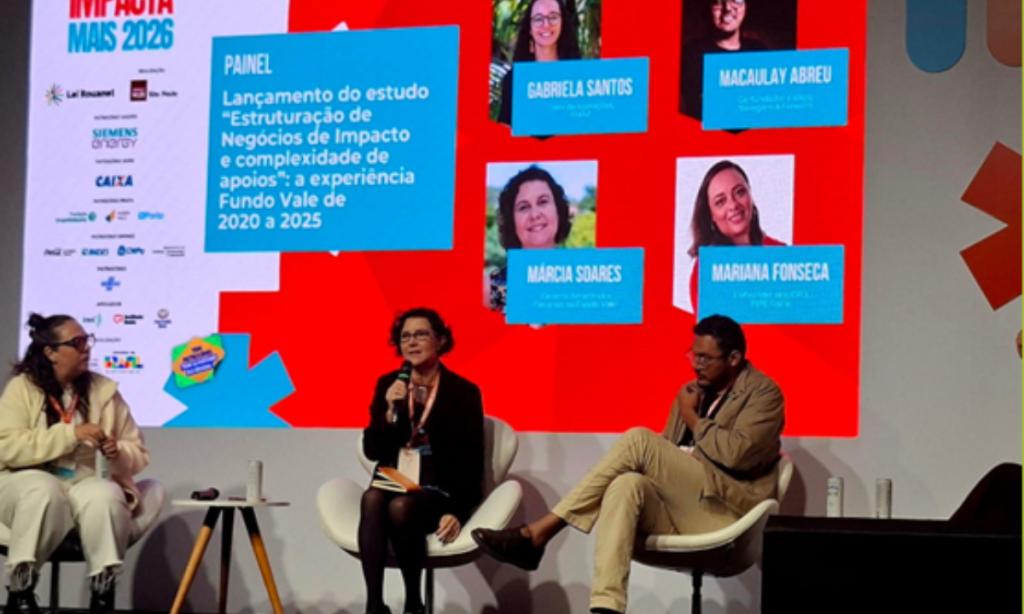
Fundo Vale is consolidating the results of its first five years of work guided by its 2030 Theory of Change. The analysis brings together data, evidence and stories that help translate numbers into tangible improvements in people’s lives and the regions where the organization operates. One of the highlights is the study “Impact Business Structuring and the Complexity of Support,” conducted in partnership with Pipe.Social, through Pipe.Labo, and Manacá Tecnologias Sociais, and launched during the Impacta Mais forum on June 21 in São Paulo.
The study grew out of insights generated through monitoring Fundo Vale’s portfolio using GIMPACT, the organization’s proprietary impact measurement and management model, developed to track progress under its Theory of Change. Today, GIMPACT monitors more than 880 ventures, from which a sample of 114 enterprises was selected for in-depth analysis in this report. The study focused specifically on one outcome: well-structured social and environmental impact businesses that generate financial returns and have the potential to scale up.
“This study helps us better understand how different forms of support contribute to the maturity, financial sustainability and scalability of these solutions. By sharing these lessons, we hope to strengthen the impact ecosystem and provide funders, catalyst organizations and other organizations with insights that support decision-making focused on long-term impact, scale and sustainability,” explains Márcia Soares, Fundo Vale’s Amazon and partnerships manager.
Results
Based on the selected sample, the study shows that the impact ecosystem is advancing through a significant number of formally established businesses that are generating revenue and strengthening value chains, while still facing major challenges in achieving financial sustainability. The analysis indicates that the most consistent progress occurs when different types of support are combined—including nonrepayable funding, strengthening of management and governance, financial planning and market connections—rather than isolated initiatives focused solely on capital injections or stand-alone training.
Among the 114 ventures analyzed, 89% generated revenue during the past year, with 56% reporting annual revenue above R$100,000 and 33% up to R$100,000. Even so, more than half do not consider themselves financially sustainable, and 22% remain dependent on nonrepayable funding to maintain their operations and invest in growth. Over the course of their development, 68% have accessed this type of funding, 42% have taken out loans and 20% have received equity investments. Today, only 46% say their business is self-sustaining, dependence on donations, awards and grants remains high, and 33% are seeking investments exceeding R$1 million.
Lessons for the ecosystem
The study identifies 12 key lessons for the impact ecosystem. One of its findings is that maturity is not synonymous with high revenue or “scale” in the traditional startup sense. The businesses analyzed tend to evolve in cycles: they increase sales, strengthen management and governance, refine their business model and then begin another growth cycle. Growth appears less as the result of a solid foundation than as a strategy for achieving financial balance, reinforcing the importance of support that combines patient capital, financial management and governance, rather than incentives focused solely on scaling up.
Another group of findings shows that impact, place-based development and support go hand in hand, although important gaps remain. In 87% of cases, the social and environmental challenge and the proposed solution are well aligned, generating local income and strengthening social and biological diversity value chains. However, 69% of businesses still do not measure their impact systematically and face challenges in communicating results and positioning their brands. The study indicates that support programs leave a stronger legacy when they reach businesses during the structuring stage and provide integrated support packages that include management, governance and communications. It also shows that recognizing businesses already serving as local hubs helps strengthen other ventures in their value chains.
What works in practice: combined support is more effective than isolated initiatives
The study finds that business progress depends not only on the amount of funding available but also on how support is designed. Interviewed entrepreneurs said that the strongest results come when financial resources are paired with capacity building. Combining nonrepayable funding with support in management, governance, financial planning and market connections consistently emerged as a key factor in helping businesses strengthen their operations, test business models, gain traction and prepare for larger investments.
Programs that provide medium- and long-term support, including close mentoring and flexibility to adjust along the way, are viewed as more effective than one-off initiatives focused only on short-term training or funding. The study also indicates that support tailored to the realities of value chains—which are often affected by seasonality, logistics costs and the need for upfront investment—is more effective when it offers longer time horizons, greater flexibility in the use of resources and explicit alignment with the intended social and environmental impact in the region.
Business maturity
The survey shows that half of the businesses have been operating for more than five years, while nearly a quarter have been in business for over 10 years. Even so, 40% consider themselves to be in the business structuring stage, 40% in the growth stage and only 2% at the scaling stage. Qualitative analysis indicates that these ventures follow a cyclical path: they increase sales, return to strengthen management and governance, seek additional funding, refine their business model and then resume growth.
The analysis indicates that many businesses continue to face limited cash-flow predictability, seasonal revenue, high logistics costs and the need for upfront investments throughout their value chains.
The study also highlights businesses that serve as local hubs by helping other organizations and cooperatives with business formalization, technical assistance, logistics and market access.
Bioeconomy sectors and value chains
By sector, most businesses are concentrated in Agriculture and Food Systems (41%), Forests and Land Use (41%) and Industry (30%). There is a major presence in bioeconomy value chains such as açaí, cocoa, Brazil nuts, palm species and non-timber forest products, which account for 77% of the initiatives mapped. From the perspective of the UN Sustainable Development Goals, the strongest alignment is with Responsible Consumption and Production (SDG 12), Zero Hunger (SDG 2) and Industry, Innovation and Infrastructure (SDG 9).
Impact measurement
In terms of impact, the study found a strong alignment between identified problems and proposed solutions. In 87% of cases, the social and environmental challenge is clearly defined and the solution directly addresses that challenge. Impact is embedded in the business model itself, whether through local income generation, forest conservation or the productive inclusion of communities.
On the other hand, 69% of businesses still do not measure their impact systematically: 25% have not defined any indicators, 44% have indicators but do not use them regularly and only 26% have formal monitoring processes, whether internal or externally audited. This makes it more difficult to translate impact into evidence, a compelling value proposition and, in many cases, access to capital aligned with the results being generated in the region.
Communications challenge
For impact businesses, communication means more than selling a product—it also involves conveying the social and environmental value of the solution and educating the market about social and biological diversity, regeneration and productive inclusion. Interviews indicate that although many entrepreneurs maintain an active presence on social media, websites and other digital channels, they still face challenges related to brand positioning, impact storytelling and producing reports tailored to different audiences.
GIMPACT
Fundo Vale’s impact measurement and management model was developed in 2021 to measure and manage the results and impacts of its initiatives through 2030. With a focus on efficiency, transparency and governance, GIMPACT establishes the foundations for demonstrating the organization’s contribution to high-level change over the short, medium and long term. In practice, it enables Fundo Vale to track which outcomes are closer to being achieved, based on the assumptions, strategies, target audiences, expected outcomes and intended impacts defined in its 2030 Theory of Change.
For this study, a mixed quantitative and qualitative methodology was used. Researchers analyzed responses from 114 businesses that participated in programs supported by Fundo Vale between 2020 and 2025 using a questionnaire containing 53 open- and closed-ended questions administered during the second half of 2025. The sample was drawn from approximately 660 invited ventures, of which 188 responded to the survey. Only seven reported having ceased operations. In addition to the quantitative data, researchers conducted 34 in-depth interviews with entrepreneurs selected to represent different programs, levels of maturity, revenue ranges, legal structures and impact profiles.
The study also included interviews with four partner organizations that implement support programs backed by Fundo Vale and compared current results with a historical database of 95 businesses from the Impact Base developed by Pipe.Social and Quintessa. The statistical analysis was conducted with an approximate 7% margin of error and a 90% confidence level.