
Featuring Geoffrey Hawtin, winner of the 2024 World Food Prize, the event stressed that agricultural biodiversity is a strategic asset for food security
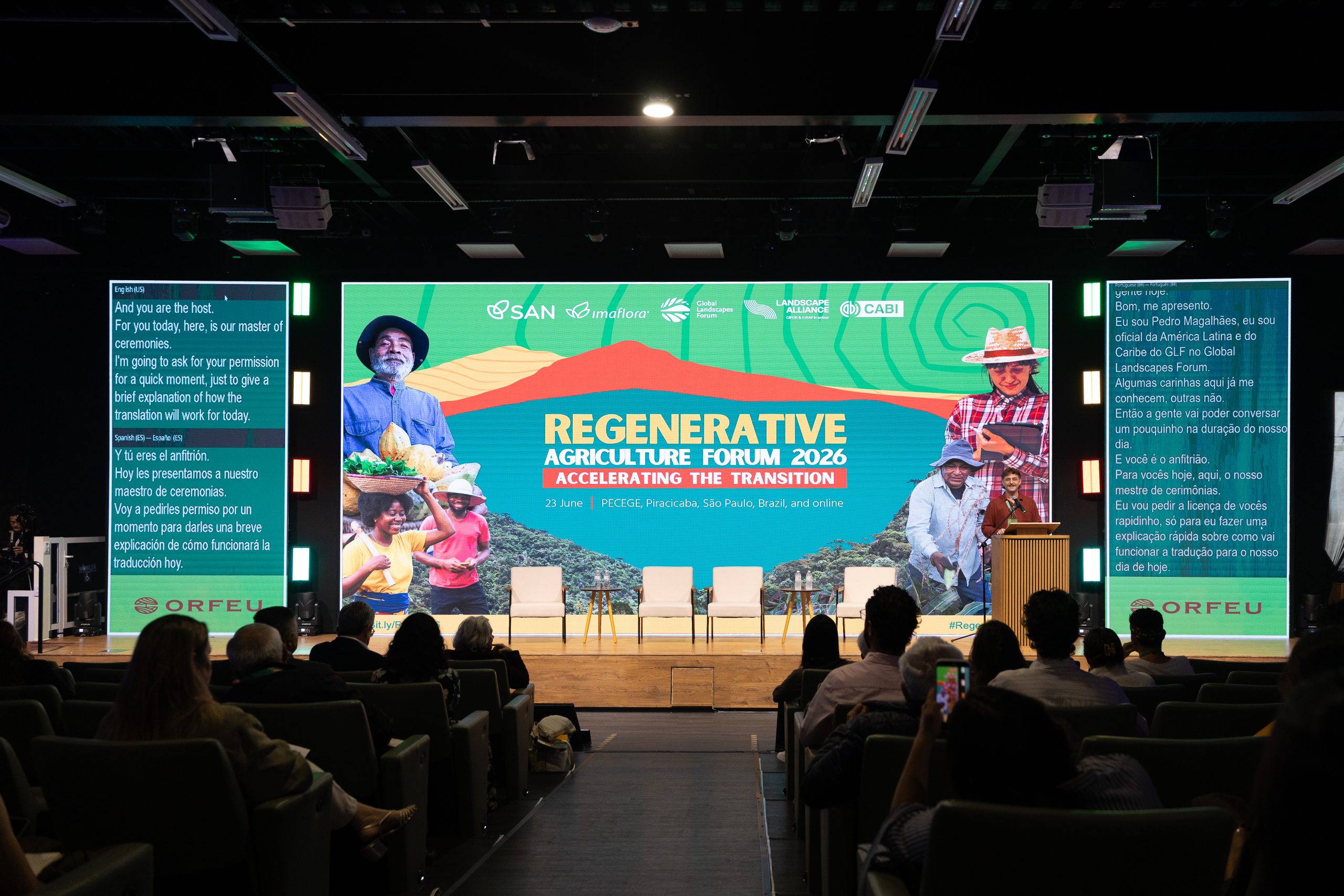
On June 23, Piracicaba, São Paulo, hosted the first Brazilian edition of the Regenerative Agriculture Forum, one of the world’s leading international events dedicated to transforming food and production systems. This year’s event, whose theme was “Accelerating the Transition,” brought together scientists, producers, investors and business leaders to identify ways to scale up solutions that regenerate soil, protect biodiversity and strengthen climate resilience without sacrificing productivity. The participation of Dr. Geoffrey Hawtin, recipient of the 2024 World Food Prize—the “Nobel Prize of Agriculture”—reinforced a clear message: agricultural biodiversity is a strategic asset for food security and the competitiveness of the agricultural sector. Another key theme was financing, highlighted as an essential bridge between ambition and scale.
Supported by Fundo Vale, the forum was organized by the Global Landscapes Forum (GLF), the Sustainable Agriculture Network (SAN), the Institute for Forest and Agricultural Management and Certification (Imaflora) and the CABI BioProtection Portal, with support from Café Orfeu. The event was produced by Pecege. The choice of Piracicaba, recognized for its leadership in agricultural science and innovation, helped connect global discussions with Brazilian experiences while bringing together different links in the value chain around practical solutions for the field.
Throughout the day, the activities reflected a new stage in the conversation about regenerative agriculture. Rather than focusing on why the transition is necessary, the panels and discussions centered on the pace and conditions required to make it happen consistently, with measurable results and economic viability.
The event brought together leaders from the investment and green economy sectors, including Ricardo Abramovay, Talia Smith and Elizabeth Adu, along with representatives of global organizations and companies, to discuss how to reduce financial barriers and accelerate the transition through financing mechanisms better aligned with the risks and time horizons of agriculture. The panel “Making the Transition Possible: Incentives and Financing for Regenerative Agriculture” featured Juliana Vilhena of Fundo Vale, alongside Saulo de Souza of the Landscape Alliance, Alexandra Tuinstra of Root Capital, Talia Smith of the Circular Bioeconomy Alliance and impact investor Phyllis R. Caldwell.
“The Regenerative Agriculture Forum, held in Brazil for the first time, was an important opportunity to advance the development of biodiverse and resilient production systems, strengthening the expansion of agroforestry and social and biological diversity value chains. The participation of global and Brazilian experts demonstrates the importance of technical and strategic collaboration focused on regenerative agriculture, biodiversity conservation, climate change adaptation and food security,” said Juliana Vilhena, Fundo Vale’s strategy, management and impact manager.
Biodiversity as a resilience strategy
Geoffrey Hawtin’s participation added technical depth and urgency to the discussion by repositioning agricultural biodiversity as a fundamental driver of resilience. Drawing on his experience with the research centers of the Consultative Group on International Agricultural Research (CGIAR) and the international organization Crop Trust, he emphasized the role of crop genetic diversity in sustaining productivity and supply chain stability under increasingly severe climate conditions, pest pressures and water stress.
A central takeaway from the forum was that preserving biodiversity is not only a conservation measure, but also a risk management and business continuity strategy, particularly for production systems exposed to extreme weather and volatile input markets.
Sustainable solutions require support aligned with regional realities
GLF’s regional coordinator for Latin America and the Caribbean, Isabel Mesquita, said, “Unlike conventional agriculture, which can degrade soil and depends on chemical fertilizers and pesticides, regenerative agriculture offers a more sustainable approach by promoting crop rotation, biological control and biofertilizers.”
The discussion was reinforced by experts including José Roberto Postali Parra of the University of São Paulo’s Luiz de Queiroz College of Agriculture, a leading authority on biological control, as well as international representatives from the CABI BioProtection Portal, who focused on agronomic performance, implementation quality and adoption conditions. One of the key lessons highlighted was the importance of technical assistance and knowledge-sharing models that reflect regional conditions and agricultural calendars and deliver predictable results, ensuring that promising solutions move beyond pilot projects.
“Radical” collaboration to unlock scale
Collaboration emerged not only as a theme, but also as a working method. The forum featured immersive Living Labs, networking sessions and exchanges centered on practical case studies, culminating in the collaborative development of a Radical Collaboration Manifesto designed to guide actions and commitments for accelerating the transition in the coming years. The underlying message was that regenerative agriculture cannot expand through isolated initiatives. It requires coordinated efforts among producers, scientists, businesses, financial institutions, policymakers and community organizations to enable widespread adoption, avoid information asymmetries and reduce implementation barriers.
Brazil’s leadership in the regenerative agenda
According to Imaflora, the event highlighted a new phase of practical transformation. Eduardo Trevisan, the institute’s ESG and certifications director, said, “Bringing some of the world’s leading experts on this topic together in Brazil creates a unique opportunity to accelerate connections, share experiences and turn knowledge into concrete action in the field. The country has the technical expertise, biodiversity and innovation capacity to lead this transformation.”
Women’s leadership and inclusion in the transition
In a year recognized by the UN Food and Agriculture Organization (FAO) as the International Year of the Woman Farmer, the forum connected visibility with practical action, emphasizing that access to capital, technical assistance, market networks and decision-making spaces is essential to ensuring consistent and lasting change in agriculture.
The discussion on women’s leadership brought together investors, executives, producers and leaders from different regions to examine how inclusion and governance influence the transformation of food systems. The participants included Elizabeth Adu, Phyllis R. Caldwell, Teresa Corção, Nancy Reyna López, Julia Bolton of the International Finance Corporation (IFC), Isabela Pascoal Becker of Daterra.
Metrics, carbon and traceability as the foundation of credibility
Throughout the forum, the discussions reflected global pressure to transform food systems in response to climate change and increasingly demanding market expectations. In this context, the event reinforced an operational lesson of particular relevance to the impact ecosystem: the transition requires measurement and monitoring systems that reflect the realities of farming.
Carbon monitoring, soil and biodiversity indicators and traceability were highlighted as essential infrastructure for building credibility and accessing markets, while also representing potential bottlenecks if they become too costly, too complex or disconnected from day-to-day farming operations. The practical conclusion was that effective measurement systems must be both robust and practical, generating confidence without creating barriers to adoption.