
Our 2020–2025 Impact Report presents our main results and lessons learned in the past five years of work on initiatives focused on the bioeconomy, land restoration and strengthening the social and environmental impact ecosystem. Resource mobilization is a highlight: every R$1 invested by Fundo Vale leveraged around R$5.90 from other sources.
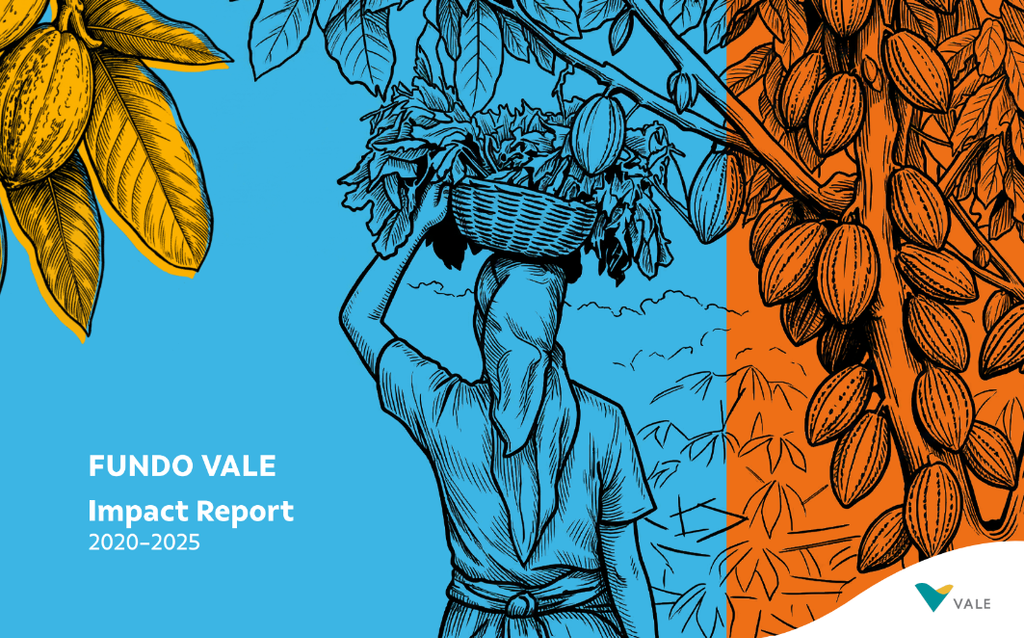
Fundo Vale, a development fund established by Vale to support the forest and climate agendas, presents its results and lessons learned in the past five years in its 2020–2025 Impact Report. The publication also looks back at milestones in the organization’s journey. Since 2009, we have supported 169 initiatives and 887 impact businesses, mobilized R$576 million, contributed to the restoration of 25,364 hectares through sustainable systems, and directly and indirectly impacted more than 60,000 people.
In 2020, Fundo Vale structured its 2030 Theory of Change, cementing a long-term vision to guide its work, resource management and monitoring of the impacts generated. Since then, the organization has directed its efforts based on defined objectives and outcomes to strengthen its contribution to the forest and climate agendas.
Its work has been organized around five complementary areas: capacity building, financial resource mobilization, support for social and environmental impact businesses, contributions to Vale’s sustainability commitments, and participation in coalitions to strengthen the ecosystem.
Launched during New York Climate Week, Fundo Vale’s 2020–2025 Impact Report analyzes the evidence, reflections and knowledge built up during this period and over the organization’s 16 years of operation. Developed in partnership with Move Social, Pipe.Social and Manacá Tecnologias Sociais, the report presents cases and lessons from financial and nonfinancial support models, work in the Amazon, promotion of the bioeconomy, and land restoration through sustainable systems in different biomes.
“Over the years, through continuous assessment of results and opportunities, we have restructured our strategy to enhance our support through innovative financial arrangements and strengthen governance and capacities across different areas of the positive impact ecosystem. Sharing experiences and lessons transparently, as we do in this report, is part of a systemic, collaborative approach to generate knowledge and boost social, environmental and economic impact across Brazil’s forest and climate agendas,” says Fundo Vale director Patrícia Daros.
Catalytic capital: every R$1 invested by Fundo Vale mobilizes around R$5.90 from other sources
One of the report’s highlights is the evolution of Fundo Vale’s work to mobilize resources for the forest and climate agendas. In recent years, the organization has broadened its focus by creating conditions that enable social and environmental initiatives and sociobiodiversity businesses to achieve financial sustainability and scale. Between 2020 and 2025, every R$1 invested by Fundo Vale as catalytic capital mobilized an average of R$5.90 in additional funding from philanthropic, public and private sources and the traditional financial markets.
This strategy combines the creation of innovative financial instruments, blended finance structures and other cooperation arrangements to expand access to resources for the bioeconomy, land protection and restoration, and nature-based solutions. The capital structure and Fundo Vale’s role are adapted to the needs of each initiative, taking into account its stage of maturity and objectives.
“In practice, catalytic capital has been used to reduce the risks perceived by funders and investors and to enable private capital to enter initiatives that are still at an early stage. In blended finance structures, this capital can take subordinated positions, absorb potential first losses or serve as a guarantee. In this way, we do not replace traditional capital but create conditions for it to reach businesses and solutions that would otherwise have difficulty accessing financing,” Daros explains.
Amazon and the bioeconomy: strengthening those who protect the forest
Supporting collective and innovative solutions has been one of Fundo Vale’s strategies for promoting the development of the impact ecosystem in the Amazon. In recent years, its work in the biome has been strengthened through partnerships focused on tackling the complex structural challenges of local areas and promoting business models based on keeping the forest standing while fostering local socioeconomic development.
“Bringing together complementary expertise is essential to strengthening sociobiodiversity value chains and businesses. Through public policies, diversification of capital sources, science, innovation and the experience of civil society organizations, it is possible to address bottlenecks and unlock the bioeconomic potential of Amazonian areas. The report presents various examples of our work through networks and shows that providing nonfinancial support and strengthening the ecosystem is just as important as catalytic capital in enabling businesses and initiatives,” says Márcia Soares, Fundo Vale’s Amazon and partnerships manager.
Vale’s 2030 Forest Goal drives land restoration through sustainable systems
Vale’s 2030 Forest Goal is a voluntary initiative that aims to protect and restore 500,000 hectares by the end of the decade, beyond the company’s legal obligations and operational boundaries. To date, approximately 45% of this commitment has already been achieved, equivalent to around 225,000 hectares.
Fundo Vale leads the restoration component of the 2030 Forest Goal, which entails restoring 100,000 hectares by the end of the decade through sustainable models such as assisted natural regeneration, agroforestry systems, simplified intercropping and integrated crop–livestock–forestry systems. Between 2020 and 2025, Fundo Vale invested R$292 million directly in supported businesses and allocated an additional R$38 million to nonfinancial support, contributing to the implementation of more than 25,000 hectares.
The initiative has involved 20 strategic partners that have contributed across a range of areas, including the economic and financial assessment of projects, acceleration programs, research and innovation, technical support for implementing systems and social and environmental safeguards, impact measurement and evaluation, and other activities. Working across different biomes has provided lessons on the importance of adapting models and approaches to local environmental, social and economic characteristics.
A laboratory for innovation and learning
Since 2009, Fundo Vale has operated at the intersection of capital, technical support, knowledge generation and dissemination, and multisectoral collaboration, seeking to strengthen the impact ecosystem. By structuring blended finance vehicles, supporting organizations and initiatives, and participating in national and international coalitions, it has helped connect communities, government bodies, investors, businesses, academia and civil society organizations.
Experience shows the need to adapt approaches, work with partnerships rooted in local areas and recognize the long cycles associated with land use transition. In analyzing these lessons, Fundo Vale shares evidence, reflections and references developed throughout its work, contributing to better-informed decisions and helping strengthen initiatives focused on generating environmental, social and economic outcomes.
Download the report to learn more about this journey.